 SIGN UP NOW FOR YOUR FREE TRADING CARD
SIX STRING SAMURIA – Awesome Comics
- Posted by PETER A DELUCA AKAPD
- On May 11, 2026
- 2026, awesome comics, rob liefeld, six string samurai, vids, vidz, YouTube, youtube video
SIX STRING SAMURIA – Awesome Comics | Rob Liefeld Retrospective Join Peter A. DeLuca (AKAPAD) for Extreme Monday as we break down the 1998 Six String Samurai one-shot from Rob Liefeld’s Awesome Comics.
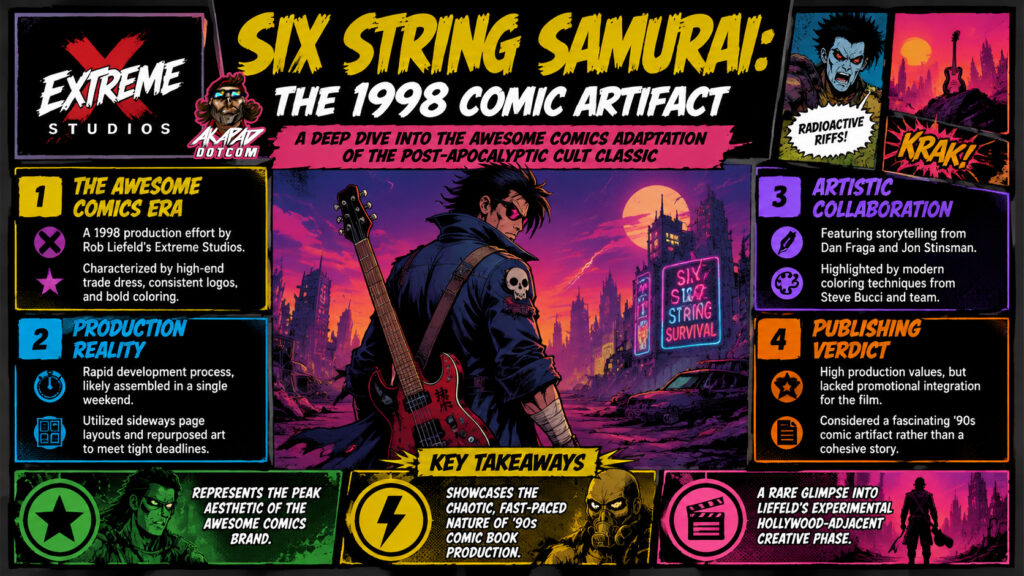
From Liefeld becoming a millionaire at 27 to the ambitious cult film’s attempt at a full multimedia empire (comics, sequels, animation, toys), this video covers the highs of Awesome’s peak production quality and the publishing challenges that followed. We compare Dan Fraga’s dynamic, cinematic storytelling with John Stinsman’s pages, discuss the movie’s wild post-apocalyptic Buddy Holly/samurai vibe, and examine the missed marketing opportunities.
If you love 90s indie comics, Extreme Studios, or hidden gems like Six String Samurai, this is essential viewing.
Summary
The video provides an in-depth retrospective on Rob Liefeld’s career, especially focusing on his work during the late 1990s with Extreme Studios and Awesome Comics. It begins by celebrating Liefeld’s achievement of becoming a millionaire at age 27 and explores his significant influence on American comics and culture. The core of the discussion revolves around the comic Six String Samurai, a cult classic film and comic hybrid released in 1998, highlighting its visionary nature and the ambitious multimedia franchise it aimed to spawn, including potential sequels, animated series, and action figures.
The video delves into the artistic and publishing aspects of Six String Samurai comics, analyzing contributions by Rob Liefeld and his collaborators like Dan Fraga and John Stinsman. The discussion contrasts Fraga’s dynamic storytelling with Stinsman’s more static style, noting both strengths and weaknesses. It also touches on the comic’s production speed, marketing shortcomings (such as lack of advertisements for the film), and the use of page layouts that sometimes felt stretched or inefficient.
Connections between Liefeld and Hollywood, through family and professional ties, are explored, particularly in relation to the film’s production and distribution. The video highlights how Extreme Studios was a launchpad for many creators and how their work intersected with Hollywood’s creative agencies and entertainment business. The narrative further explains the movie’s apocalyptic rock-and-roll setting and its story, ending with the Six String Samurai’s final battle and the passing of the torch to a young successor.
The video concludes by emphasizing the cultural significance of Liefeld’s era in comics and reiterates the channel’s dedication to deep explorations of 1990s comic history, focusing on Extreme Studios, Top Cow, and other prominent creators of the decade.
Highlights
- [00:00:10] 🎉 Rob Liefeld became a millionaire at age 27, marking a major milestone in his career.
- [00:01:30] 🎸 Six String Samurai was poised to be a major multimedia franchise with sequels, animated series, and merchandise.
- [00:02:10] 🎨 Awesome Comics reached a peak in quality with consistent artwork, logos, and coloring during Liefeld’s prime.
- [00:04:05] 🎥 Rob Liefeld’s Hollywood connections influenced the development and distribution of Six String Samurai.
- [00:07:15] ⚔️ Dan Fraga’s storytelling in the comic adaptation provided a more cinematic and dynamic narrative compared to John Stinsman’s static style.
- [00:09:44] 🎶 Music played a significant role in the Six String Samurai universe, with bands like the Red Elvises adding to the film’s atmosphere.
- [00:14:08] 📉 The comic’s publishing had flaws: lack of movie promotion, stretched page layouts, and missed opportunities for additional content.
Key Insights
- [00:00:10] 💰 Rob Liefeld’s early financial success at 27 highlights the lucrative potential of 1990s comic creators who capitalized on the boom era of independent studios and creator-owned properties. His achievement reflects a rare combination of artistic talent and entrepreneurial savvy that shaped the comic book industry’s business model.
- [00:01:30] 🎥 Six String Samurai exemplifies the 90s trend of cross-media storytelling, where comics, films, and merchandise were integrated into a single property’s ecosystem. Although the film had a limited budget and distribution via VHS, its cult status and visionary approach underscore the era’s experimental spirit in entertainment. The movie’s apocalyptic rock-and-roll theme created a unique niche blending punk aesthetics with martial arts and post-apocalyptic narratives.
- [00:02:10] 🎨 Awesome Comics’ trade dress and consistent visual identity under Liefeld’s leadership were crucial in establishing a professional and appealing brand. The use of distinct logos, information boxes, and high-quality coloring elevated the publisher’s profile, making it a significant player in the 90s independent comic scene. This consistency helped build fan loyalty and attracted talent who would later influence mainstream comics.
- [00:04:05] 🌐 Liefeld’s ties to Hollywood, whether through family, romantic relationships, or industry connections, illustrate the increasingly porous boundary between comics and film during the late 90s. These relationships likely facilitated attempts to adapt properties like Six String Samurai into broader media forms, though the complexities of agency relationships and distribution deals often complicated these transitions.
- [00:07:15] ✍️ The contrast between Dan Fraga’s cinematic storytelling and John Stinsman’s more static approach reveals the varying artistic interpretations within Extreme Studios. Fraga’s dynamic paneling and visual effects capture the energy and tone of the original film more effectively, while Stinsman’s work, though functional, lacks the narrative innovation needed to fully engage readers. This disparity reflects broader challenges in adapting film properties into comics.
- [00:09:44] 🎵 The integration of music into the Six String Samurai universe, particularly through bands like the Red Elvises, highlights the multimedia ethos of the 90s indie scene. Music was not just an accompaniment but a narrative and atmospheric component, enriching the story’s immersive quality. This approach anticipated later transmedia storytelling techniques that blend soundtracks with visual media to deepen audience engagement.
- [00:14:08] 📉 Despite the creative ambition, the Six String Samurai comic suffered from publishing missteps such as lack of promotional content for the film, overextended page layouts (turning single pages into two), and a missed opportunity to include pinups or additional material that could have enhanced reader value. These issues illustrate the tension between rapid production and quality control, a common problem in independent comics that sought quick market impact without sufficient marketing synergy.
00:00:10
Rob became a 7 million man at age 27. >> Aka Patterns. If it’s Monday, that means it’s extreme Monday. The celebration of Rob Lyfeld and Extreme Studios everything ‘9s. Now, here’s the thing. Sometimes we go outside of the 90s. Sometimes we go in the other direction, the way of the 80s, but the focus is Rob Linfeld, his career, his collaborators, and his overall contribution not just to American comics, to the American culture. Now, here’s the kicker. I loved, admired, appreciated Rob
00:00:49
Livefeld’s career for my entire life, aka Patter. I was there at ground zero the day X4 Summer one dropped. I had to have all of the trading cards. But hey, hey, hey, we’re adults now. We can look at things. We can be critical. So, it’s Rob Lifel. Extreme Mondays. The good and the bad. Rock and roll. Aka Patter. Good morning. Get yourself some of that hot Java. Rob Livefeld’s awesome comics. Here’s here’s a couple more of them. We’re talking Six String Samurai issue one of one by the way.
00:01:30
Never got an issue two. It’s not really set up for a second issue. Th this is more set up to showcase a potential giant franchise, multiple sequels, animated series, action figure line. Six String Samurai, if you remember it, was set up to be the next big thing. I believe it’s 1998 is is when the movie came out. VHS era. You you you had to hunt down the VHS. But this was one of the movies to see at one time. I still believe it’s a visionary work. But let’s get we’re here for comics. So this, if
00:02:10
you guys don’t remember, Awesome Comics had some amazing trade dress. I mean, look how that lines up. They had the exclamation point for the information box, the corner box. This time in Rob Lifel’s career, it it was like the best consistent artwork, the best lineup of books, the best logos, the best coloring. This is the absolute height. And and I I want to say this is everything, not just Rob Lifeeld, but his like orbiters and the people he employed, the people that made good money through Rob Lifeeld,
00:02:52
everyone learned enough through Extreme Studios, Maximum Press. I mean, they they got action figures like super early. Like where’s like right here? Like here’s the Genie action figure. I forget this book. Yeah, Black Seed, right? like Black Seed never came out. Fraga had another book, but and you know, like everyone’s evolving and just like kicking ass and a part of the the evolution and let’s just say Rob Lifeeld and Friends is well, they’re connected to Hollywood to agents. Lived when he
00:03:30
talks about it on his podcast, he always seems like he came a little bit from a Hollywood family or a entertainment connected family. Now, some of this could be through like, you know, his his family, their friends, or or when he got a little bit older and started dating like Cheryl Lifel cuz she was her and her sister were both like models or they’re they’re triplets, right? Like like all three of them potentially were I don’t know. But these two guys like Lance Mangia and Jeffrey Falconee. Jeffrey Falcon.
00:04:05
This is Jeffrey Falcon. He’s a martial art artist. maybe like he’s attributed to maybe 1822 movies, but he essentially a stunt guy. And through the course of like conversations and putting this film together, it was like, “Oh, you look like Buddy Holly.” And they they transformed a lot of the the lore and the ideas around Six String Samurai and like the the world, we’ll call it, around this this idea where nuclear bomb hits Las Vegas, Russia takes over, and like it’s almost like Las Vegas is just
00:04:42
this rock and roll apocalypse. So like that’s the whole setup. That’s everything we get here. But Lyfeld here, he’s he’s credited as story consultant, but he’s he’s connected to these guys in in some way. And it’s not he talked about it a little bit on his podcast and it’s still like not clear if even even he’s uh maybe associated or some of his his his Hollywood friends at this point or or entertainment friends like are associated with Palm Pictures. Not 100%
00:05:18
but you kind of see a little bit I call these like they’re agency relationships. They’re like CA like creative artist agency comes in. They pick up a property, they line up the distribution and and the company purchasing like a hot commodity and they’re like, “Hey, this should be a comic. We we like now like we have this guy in our rolodex. Give them a call.” So Rob Lifel in this afterwards like talks about how he he watched the first like five minutes of the movie and was just like I need to make this
00:05:57
into a comic book. And then he talks about Matt Hawkins and and all the other guys coming in to make it happen. But they wanted to create stories that were in the world of Six String Samurai. Now, if you watch Six String Samurai, which is for free on YouTube, I’ll put the link of that down below. Here’s the wild thing. Like, you know, like, all right, like, do you only watch five minutes and then like you get comic book spin-offs and adaptations through it? Because like the way that the movie ends, which we kind
00:06:35
of get here in the Fraga segment, and we have guys, we have Frager and John Sinsman, right? We have two of the Extreme Studios Maximum Press alumni rocking and rolling on this. The Dan Frager piece, which on the storytelling sense, considerably different than John Sinsman. John Sinsman never evolved as a storyteller, never rotated the camera, never experimented. Uh everything was a twin shock mo like right. But Frager here like he tells the story of the end of the movie essentially which is the
00:07:15
kid that the six ring samurai and and and this is a little bit nuts because if you watch the end of the movie six ring samurai is just a littered with arrows. It’s such a cool like final fight scene and and again like these guys have no budget and the movie just looks it it’s a nobudget movie that looks like apocalyptic wasteland but yeah six ring Samurai here fights death and they do in the mo like this is a little bit of the optical effect that they do within the movie which is death is like the face is on scene he’s almost
00:07:54
like a ring wreath and And they they flashed the skull like one time. It’s so freaking cool. Such a good payoff. But yeah, so Death Kills and we can’t read this. This is this is unreadable. I can read it a little bit a little bit better through the lens here, but the kid picks up the sword and kills death and then uh takes on the journey to Las Vegas. And that’s how like the movie ends. It’s it’s a really satisfying, really smart ending. So, Frager comes in like 20 years later and
00:08:30
basically retells the end of the movie. So, so a lot of this where they wanted stories to add to the lore of the film and and other things like the Fraga piece doesn’t add up. And then like the John Stzman piece we want to say are all pages that they turn sideways to get two pages out of. I don’t blame Stinsman. I think they put this book together when when Lifel got the call that this could have been the right like this is of the time of this masterpiece, right? Like you were it was almost saying like this could be the
00:09:06
next Desperado Elriiachi. This could be the next Spawn. This could be the next Blade or um Dark City, right? Like this is everything that would orbit this. I have a feeling they put this thing together in a weekend. But yeah, Stman, six string samurai with the kid with the raccoon tail, which has also a payoff at the end. They wander into, you know, like a little bit of a diner, a little bit of a music joint, and they a gang barges in there. We have music. So, a lot of the the way how the music runs
00:09:44
through this is it’s another piece within the movie. I think they were called like the Red Elvises. Really great band there. They were more like Scott, like the money boss tones. Go like look them up after you watch the movie. But the music element that we get in the movie, we we get it here. But these are all quick drawings. And look, we get like two pages, right? two full pages and then we get what’s clearly the next page split into two but six string samurai I mean you know well drawn here
00:10:20
well colored uh he knows he’s going to have to fight some people and then we get another two pages that are that’s essentially one page and these are quick renderings and and Stinsman like Stinsman was the workhorse that kept the vendulin going which was the cash flow for uh all of the when the extreme universe started to die down and everything became John Stinsman. No one gives Stinsman’s credit for keeping that book afloat. I never succumbed to his style even though we we have right we’re
00:10:56
both from Hall of Heroes New Jersey. uh Johnston. This guy and I worked at the same comic shop, which is a kind of wild. I I never really met him either, but not that I even care. But, uh he does have a GoFundMe. Maybe I will link that down below. Uh he has fallen on uh health issues, but with we’re not here to talk about Sinsman. Maybe we’ll do a separate Sinsman video. But we get some like fantastic coloring of the four like I mean this is even colored by the Steve but Brian Bachelto Don Skinner I
00:11:29
tried to look up Don Skinner I couldn’t get anything solid for him and and Brett Evans Evans and Skinner and Botch Saletto uh really like the the new hotness there. And I think there was a Steve actually, right? Like a Steve the bucketto. Is Steve another bucketto. Six string samurai slays everyone. Great coloring. I love the the shots of blue here. Then we get another single page turned into a two-page and he’s like uh death hasn’t caught up to me yet. And which kind of foreshadows the next story where
00:12:08
death kills him. Kind of cool. But look, look at the Fraga stuff, man. Like Fraga is really into like he is a full storyteller by this point. And then we get, you know, a uh very jumpy jump. We’re facing each other. We’re clanging. Person falls. Person dies, right? And look, he’s falling right into the jukebox. And he’s like, “Hey, kid. Uh, let’s just keep going.” And then this is almost like where like maybe like the movie picks up, right? So yeah, AK Patter uh we yeah you know like
00:12:49
limited reading experience. It’s a nice artifact of the awesome comics era and let let’s just pinpoint the year 1998. Yeah. uh it but as a company I think this is is somewhat good or it’s somewhat impressive that they put this thing together so quick as publish as the publisher though the publisher needs to come in and say like we’re doing too much of this we’re doing too much of the sideways we’re milking our pages a little bit too much can we get uh like you know like you want to Hey,
00:13:29
three pinups would have fixed this book. Three pin-ups. But there’s also like no info about the movie. Like, how come there’s no ad for the movie? No info about the film at all. So, from a publishing standpoint, I think it’s it’s a failure. It’s more of a failure on publishing than anything. Also the cover AK par like right this is one of Rob Lifeld’s better covers but I feel it’s all Mr. Fraga especially look the hand the hair like it’s a Fraga hand Fraga Fraga both hands are Fraga hair is
00:14:08
Frager this little area is Rob Lyfeld but he’s also like un sheaththing the sword right so it just makes me feel like we’re zoomed in here and it’s a bigger image so if anyone after has seen like the full image of Six String Samurai number one I would love to see maybe I maybe I’ll try and research that odd artifact. But also the other note is Rob Lifeel was a part of roughly like outside the Deadpool stuff two movie adaptations, right? Or continuations, Six String Samurai and you guys know pre previously
00:14:47
featured on this channel, Mission Impossible. Awesome comics though. Like really I for as quick as this was, I it’s it’s a highlevel production. just needed a little bit more bang for uh more bang for your buck. It was it was $3. That’s a lot. We’re going to cut right in there, aka Patters, for a quick reminder. If you love 90s comics, you have found the channel for that. No other comic book channel in the history of YouTube, in the history of all of the internet goes into 90 comics as deep as
00:15:22
this. And on Mondays we focus on Rob Liyfeld Extreme Studios Extreme Mondays Tuesday Mark Sylvestri and everything that comes with him including Michael Turner Top Cow Tuesday and Jim Lee and his dominance and and his rise into the DC executive suite. Jim Lee and Wildtorm Wednesday, Monday, Tuesday and Wednesday. Nothing but that 90s content drip for all of you. Now back to the video. Heat. Heat. Heat. Heat.

AKAPAD is a versatile thinker known across Philadelphia, Europe, and even in the vast Multiverse as The Electic One. By day, he excels as an IT Mastermind, assisting individuals, both big and small, with a wide range of simple and complex solutions. In contrast, he is also a talented illustrator, a passionate comic book enthusiast, a creative content creator, and an active live streamer. Additionally, his podcast, “AKAPAD The Film Buff Podcast,” boasts an impressive catalog of over 500 episodes available on nearly every major platform.