 SIGN UP NOW FOR YOUR FREE TRADING CARD

Starstruck Comic Book: Michael Kaluta’s Dark Horse Volumes, Black-and-White Art & Manga-Style Numbering
- Posted by PETER A DELUCA AKAPD
- On April 18, 2025
- 2025, comic book commentary, comic book video, dark horse comics, vids, vidz, YouTube, youtube video
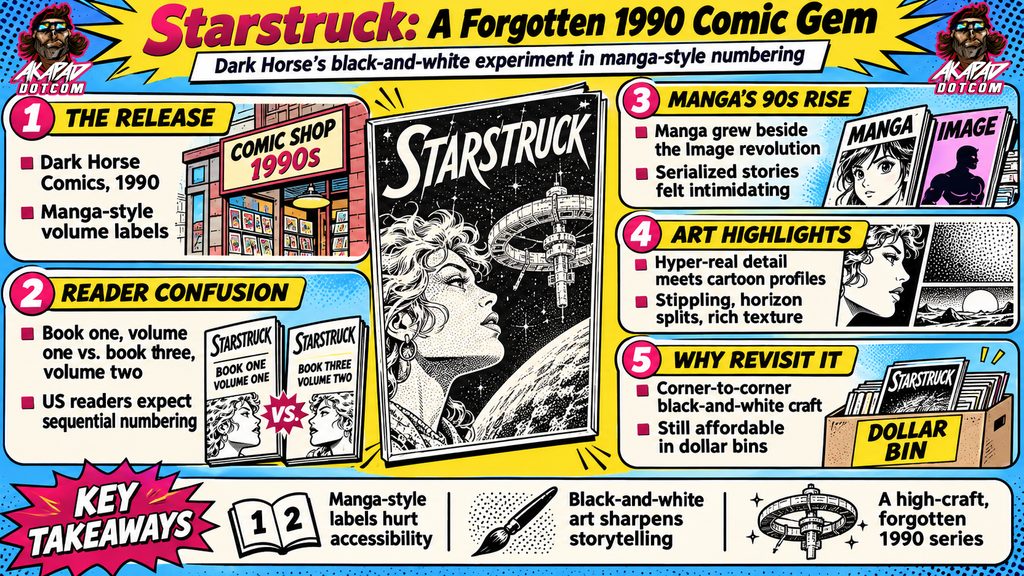
In this video deep-dive, we flip through the 1990 Dark Horse Comics Starstruck volumes by Michael Wm. Kaluta (with Elaine Lee), examining why this science-fiction series still stands out for its corner-to-corner black-and-white artistry. The manga-style volume-and-book labeling that confused many American readers in the early ’90s is just the start. Kaluta’s line work blends hyper-realistic machinery, textures, and landscapes with cartoonish character profiles in the same panels—an approach that carries more storytelling weight precisely because it was never meant to be colored. We also place the book in the broader production landscape: the fast American monthly “factory” model versus the longer European cycles that allowed more refined pen-and-ink work, and how Starstruck sits as a hybrid of both plus manga influences. If you’ve ever dug dollar bins or thrift stores for forgotten black-and-white gems, this one’s a reminder of why some overlooked titles are worth rediscovering.
Exploring the Art and Legacy of Darkhorse Comics’ Starstruck
Summary
This video offers an insightful deep dive into Starstruck, a Darkhorse Comics series from the 1990s, highlighting its unique place within both American and international comic traditions. The host examines the comic’s unconventional manga-style volume and book numbering system, contrasting it with typical American sequential comic numbering. This difference in format contributed to a barrier for American readers unfamiliar with manga conventions, reflecting the broader challenges manga faced when entering the U.S. market during the late 80s and 90s.
The video also pays tribute to Michael WM Kuda, the artist behind Starstruck, whose work demonstrates a masterful blend of hyper-realistic and cartoonish black-and-white artistry. The presentation values the comic’s original black-and-white style, emphasizing the storytelling clarity and engagement it provides over colorization. Through detailed examination of Kuda’s line work, textures, and compositional techniques, the host praises his sophisticated craftsmanship, especially in blending European and Asian artistic influences with American comic production methodologies.
Finally, the video discusses how Starstruck fits within the broader comic production ecosystems, comparing fast-paced American factory-style comics production, the meticulously crafted European models with longer lead times, and the particular hybridity seen in manga. The host expresses renewed motivation to revisit and promote Kuda’s work, encouraging viewers to seek out these largely overlooked but artistically rich volumes.
Highlights
- 📚 Starstruck volumes use manga-style magazine labeling, which confused many American readers accustomed to straightforward sequential numbering.
- 🖤 The comic employs black-and-white artwork purposefully, enhancing storytelling and artistic engagement.
- 🎨 Michael WM Kuda’s art blends hyper-realistic and cartoonish styles in a nuanced, corner-to-corner detailed approach.
- 🌐 Starstruck reflects a hybrid production style, bridging American, European, and manga comic traditions.
- 🕰️ European comics benefit from longer production times and permanent bookshelf placement, unlike American monthly comics.
- 🔄 Scene resets in Starstruck use innovative profile panels rather than lush backgrounds, showcasing unique storytelling techniques.
- 🎥 The video motivates rediscovery of Kuda’s work and previews upcoming comic features like Miami Mice by Mark Bode.
Key Insights
- 🎴 Manga’s Early U.S. Adoption and Reader Barriers: Starstruck’s labeling system, mirroring Japanese magazine-style volumes, highlights early manga publishing challenges in the U.S. market. Unlike American comics, which prioritize sequential, linear issue counts, manga’s volume-book format can confuse readers unfamiliar with serialized storytelling. This difference illustrates cultural and industry-specific reader expectations influencing manga assimilation into American comic culture during the 1980s and 90s.
- 🖋️ Artistic Craftsmanship as a Narrative Device: Michael WM Kuda’s line work spans a broad spectrum—from realistic textures and detailed machinery to exaggerated cartoon profiles in the same panel. This interplay enriches narrative tone and emotional impact. The intentional black-and-white format requires the artwork to carry more storytelling weight, demonstrating how medium limitations can fuel greater artistic sophistication and engagement rather than detract from it.
- 🏭 Contrasting Comic Production Models: American comics tend to follow a fast-paced monthly “factory” production with separate stages (penciling, inking, coloring), sometimes sacrificing finesse for speed. European comics, conversely, enjoy longer production cycles, often with permanent shelf space, allowing more detailed craftsmanship in individual issues. Starstruck’s method blends these paradigms, reflecting how cross-cultural influences affect comic artistry and publishing logistics.
- 🔄 Innovative Scene-Reset Techniques: The use of character profile silhouettes as scene resets, rather than elaborate scenic backgrounds, is an economical but effective storytelling method. This approach signals shifts and re-centers readers with minimal visual noise, illustrating how artistic choices support pacing and reader comprehension in serialized black-and-white comics.
- 🎭 The Black-and-White Medium’s Narrative Power: The video underscores a philosophy against colorizing works intended for black and white, emphasizing how monochrome art demands “refined storytelling” and can be “more engaging.” This validates the aesthetic and functional value of black-and-white comics, inviting deeper appreciation of tonal contrast, line quality, and compositional clarity that color can sometimes obscure.
- 🧑🎨 Legacy of Michael WM Kuda: Though not widely remembered today, Kuda’s Starstruck is lauded for its “corner to corner artistry,” detailed effects (like stippling for texture), and the ability to convey complex scenes with minimal visual clutter. Revisiting overlooked artists like Kuda reveals rich wells of inspiration and historic comic art methodologies that continue to influence modern illustrators.
- 📈 Importance of Rediscovery and Preservation: The host’s personal narrative of rediscovering Starstruck through thrift hunting and podcasts emphasizes the importance of maintaining comic book heritage. These “forgotten” works serve as crucial links in understanding comic evolution and cross-cultural artistic exchange, reinforcing the value of archival efforts in indie and black-and-white comics.
.00:00:03
[Music] All right, here we go. We’re bleeding this video out here. I I tried to go through this a couple times to get the information as tight as possible. I want to give you guys a flip through of Darkhorse Comics’s Starruck. It’s year 1990. And here we have, look, volume one, book one, volume one, book two, volume one, book three. The naming convention, the labeling convention used for Starruck was in tone to how the industry looked at manga. The comic book publishers looked at manga very similar
00:00:43
to magazine uh labeling. Magazines get a new volume every single calendar year. They tried something similar in the early days. Now, recently on stream, someone tried to challenge me. Uh, I don’t know why. I don’t know why you would ever challenge me. Number one, cuz you got to be 100% totally right. Uh, manga has been featured in American publishing since the 80s. It came to a head in the ‘9s, and that 10-year arc, basically within that 10 years, it never went away within the 90s. And people
00:01:19
will say, well, the ‘9s were about the image revolution, guys like Kryp here. But no, no. The other counterpart of the 90s was the rise of manga. Apple seed here. If we were to buy these like from a comic shop back in the day, we would be confused and we would feel like we’re not getting the complete story. Cuz look, book one, volume one. Easy. Book three, volume two. Book three, volume three. Book three, volume four. Book three, volume five. This confuses the American reader because we
00:01:54
like sequential numbering for our comics. Valley of the Wind here. Part two, one, part two, two. Well, I need like part one, one before I can read this. So, there there’s a little bit of an intimidation factor when we’re presented with serialized entertainment like this or a complete storyline. The other barrier to entry from American readers into manga it is that sometimes we have an ongoing and sometimes we have a a a story. So, you know, like, so manga does have like floppies versus graphic
00:02:33
novels, but it’s hard to know what what that is when we’re buying it monthto monthth and we’re seeing it monthtomonth on a American comic book direct market rack or direct market store display. I feel this numbering convention pulled readers out. So, a little bit of my contrast on my back and forth really uh of what to do Fridays is some sometimes on Fridays I just want to go over something cool, something black and white, uh something independent, something unknown and in this case something forgotten.
00:03:15
uh Kuda, Michael WM Kuda, he was written about, he was heavily written about back in the day. And believe it or not, he got memory hold. I recently uh went with with my buddy Mark from uh you guys can look it up. It’s it’s All Stuck Comics podcast. Uh maybe a link of that down below. Uh if those guys promote I’ll tell you that right now. If you promote me, I’ll promote you. But with all of that said, and I’m saying that to boss’s boss cuz I know he he watches my my my videos, my buddy Mark, uh, you know, we
00:03:55
would go dollar bin, uh, 25 cent bin, uh, 5-cent bin, uh, you know, comic book hunting, and, you know, we did that a few years ago, and I was able to rebuild a lot of my inventory with intent. And the we targeted these. We we would buy these whenever we saw them because we were just blown away. I mean guys at the level of detail here and the line work, the variety of being like we have to say like realistic and cartoony within the same panel. This is what we want to say is absolutely highlevel work. Uh this is I classify this as
00:04:35
corner to corner artistry meaning we’re drawing through the corners. I mean we’re we’re we’re we got complete panels here and we’re drawing things hyper realistic but then right in in that European method super cartooning this method also in manga but manga started with the super cartooning and then they even had a um you know like we look at Dragon Ball Z like silly faces realistic muscles right so a little bit of this push and pull is a part of the communic communication language of black and
00:05:13
white comics of this nature. I always I will say too when we flip through Star Struck, we have a position here of never to colorize anything that is that is intended to be black and white. Like it’s if it’s black and white, it’s black and white. If it’s drawn to be black and white, it’s black and white. you. We want to say because we don’t have the color, the storytelling is way more refined and it’s easier and dare I say more engaging and it pulls us in. I love how here we have
00:05:46
this like purposefully uh purposefully cartoon profile, but then the character gets realistic like the more we see him there’s there’s like this introductory process here, right? Like look, look how real that is. But guys, this comic is absolutely phenomenal. Like here, look, this chick gets her like her head blown off. We I don’t know what’s happening. And then we have like a cartoon here. We have a cartoon at the end pages. And this, you know, Jay Scott Campbell later ripped this off for a uh Danger Girl
00:06:20
sketchbook, I believe, or Danger Girl deluxe edition. There’s just something to be said when we look at art. I mean, when we look at machinery like this, when we look at landscapes like this, so a lot of times people don’t understand the contrast. And what what really is the contrast? Well, let’s just go to Don Hec real quick because I’ve been on on your Don Heck. The American style is to do this monthly to crank it out. Uh, you have a story, you have pencil, inking, coloring, lettering, but you crank this
00:07:03
out all the time. Like, you’re in a factory. It’s not as refined as a factory as we get with with Eastern comics, you know, with manga, with with the Korean comics. American comics is like this mixture of the two. Now, when we get to to the European stuff, it’s a different style. It’s a different work ethic. It’s different publishing. A lot of European comics, titles, individuals, they got permanent space on bookshelves. See, not comic shelves, on bookshelves, and on magazine racks. Permanent space.
00:07:47
So they had they had more time. They had more time to work on everything and their drawing methods dictate that to where they got really good with going from a blank piece of paper to pen and ink. uh they develop methods of somewhat uh draw like they draw out of nowhere and they have uh detailed layouts but they go from the layouts to here relatively quick. There’s a different method to their production and we see it here. Now did they have a studio system? Yes. Did they have assistants? Yes. Did
00:08:27
they have people uh walking them through the production process like a front office? Yes, but at the same time, you know, they get different results, different materials, different standards. These are all the things we have to consider when we compare stuff. But guys, I mean, like look at I mean, I just love like when he draws like this armor here and look even like the the the knit sweater like the detail. These are the things we have to be mindful of like here too like the book you know with
00:09:04
look with the with the bolts it’s almost like we know we’re not it’s not a hardback book here this is like a bound paper you know like bound loose leaf paper but like their technology like the chair here see I like here like in the background just the the stippling here see like right here because it fills up the panel and it adds like this additional texture. And for here, we’re not doing like crazy things, right? Like we’re not like moving and rotating the camera. We’re we’re splitting the horizon. So,
00:09:39
it’s like horizon split, horizon, split. We’re not uh there’s a ability to storytell, meaning you can draw anything from any angle. And then there’s craftsmanship, craftsmanship, and rendering. There’s an intersection of the two. And the only people that know that is the artist. So you can draw things in your particular way so well it’s not questioned. But I mean like look at the the leather glove here. Great texture. And here we go. Just like this technology. And guys, I just want to
00:10:16
say let’s Michael M, it might be Mail WM Kuda. Kuda here is not totally forgotten, but Kuda here is not really on the hearts and minds of current illustrators. these books. Uh, you know, like I’m not I’m not going to lie, they haven’t been next to my drawing table for a little bit, but just doing this video and sharing this with you guys, uh, I’m I’m motivated to to get as much from this guy as as possible. I mean, he does great. It’s funny, too. A lot of his like negative panels, like negative
00:10:55
background panels are uh profiles, and and I think he does that to reset the scene. So there there’s like two ways you you can reset a scene. You do it by a and we can kind of tell this was serialized, right? Because this is one story here, then this is another. I mean, this could have been serialized monthly or bi-weekly. Who knows? Uh I don’t know enough about it. But we reset scenes by doing a lush landscape, a lush background, a lush environment like we have here. Or as he does, his technique is is profiles and
00:11:35
he’s he’s developed ways. I mean guy even here with these guys carrying these like boxes like he does it’s just a profile but he works in enough in there. Like look at this dude like struggling to to keep it up. I mean, look at the freckles. I these right here. Those little rivets in the headgear. It’s just too much sometimes. It’s like too much to look at. I mean, his effects like blasting through the sun. It’s really something. A I mean, look at the space station. I wish I could come to you with
00:12:16
more about this. I cannot. This has just been in one of my to-do boxes and you know that’s a part of what we do on on Fridays is I just want to bring you guys something for you to track down and you know that’s hopefully affordable. I think these still are. So coming up next week cuz we’re we got a lot of momentum now. Next week will be the Miami Mice comic premiere issue. The first solo by our boy here, Mark Bode. Come on out, you lousy mice. Look at this. It all strung out on that
00:12:57
parmesan cheese. All right, AKAPADers. See you guys next week. [Music]
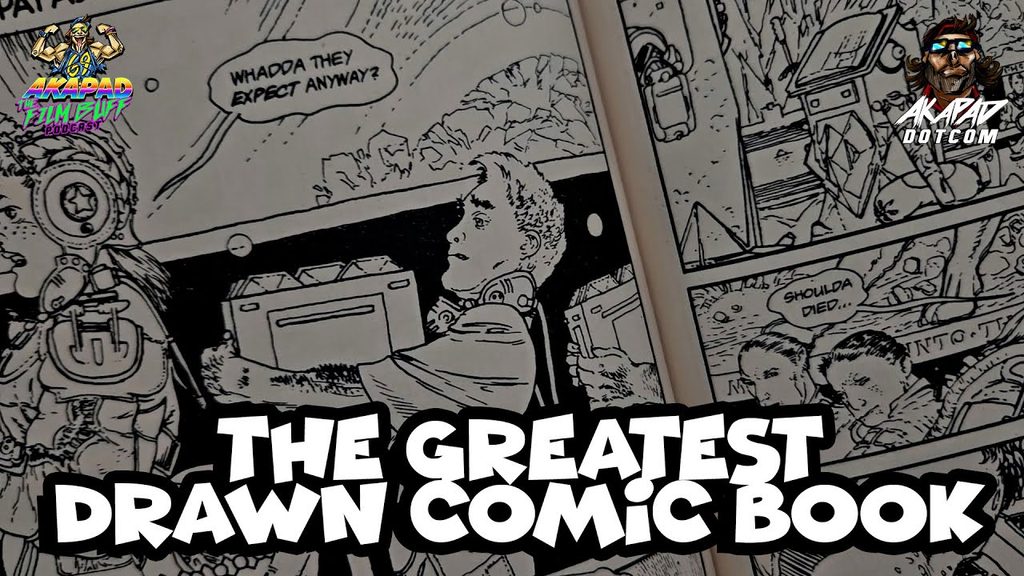
Starstruck remains a showcase of Michael Kaluta’s ability to deliver detailed, engaging black-and-white storytelling that rewards close reading of line, texture, and composition. Its manga-inspired numbering may have created an early barrier for U.S. readers, but the art itself—realistic and cartoonish elements sharing the same panels, innovative profile-based scene resets, and deliberate monochrome clarity—still feels ahead of its time. Rediscovering these Dark Horse volumes (and the larger Lee/Kaluta body of work that began in Heavy Metal and Epic) is a reminder that some of the richest comic craftsmanship sits outside the monthly superhero racks. If the flip-through sparked any memories or if you’ve hunted these yourself, drop a comment below—and stay tuned for more overlooked black-and-white and independent titles.

AKAPAD is a versatile thinker known across Philadelphia, Europe, and even in the vast Multiverse as The Electic One. By day, he excels as an IT Mastermind, assisting individuals, both big and small, with a wide range of simple and complex solutions. In contrast, he is also a talented illustrator, a passionate comic book enthusiast, a creative content creator, and an active live streamer. Additionally, his podcast, “AKAPAD The Film Buff Podcast,” boasts an impressive catalog of over 500 episodes available on nearly every major platform.

