 SIGN UP NOW FOR YOUR FREE TRADING CARD
Legend (1985) one of the greatest fantasy movies ever made – The Film Buff Review
- Posted by PETER A DELUCA AKAPD
- On November 13, 2025
- 2025, fantasy movie, fantasy movie podcast, podcast, ridley scott, talk, tom cruise
Legend (1985): One of the Greatest Fantasy Movies Ever Made – The Film Buff Review
In a world of endless CGI blockbusters and forgettable fairy tales, Ridley Scott’s Legend (1985) stands apart as a breathtaking, underappreciated masterpiece of pure visual storytelling. Tom Cruise, Mia Sara, and a scene-stealing Tim Curry as the demonic Darkness bring to life a dark, romantic fairy tale filled with unicorns, enchanted forests, and timeless themes of innocence, love, and evil. Yet for decades, this Ridley Scott gem has been overshadowed and dismissed as “just that Tom Cruise movie.”
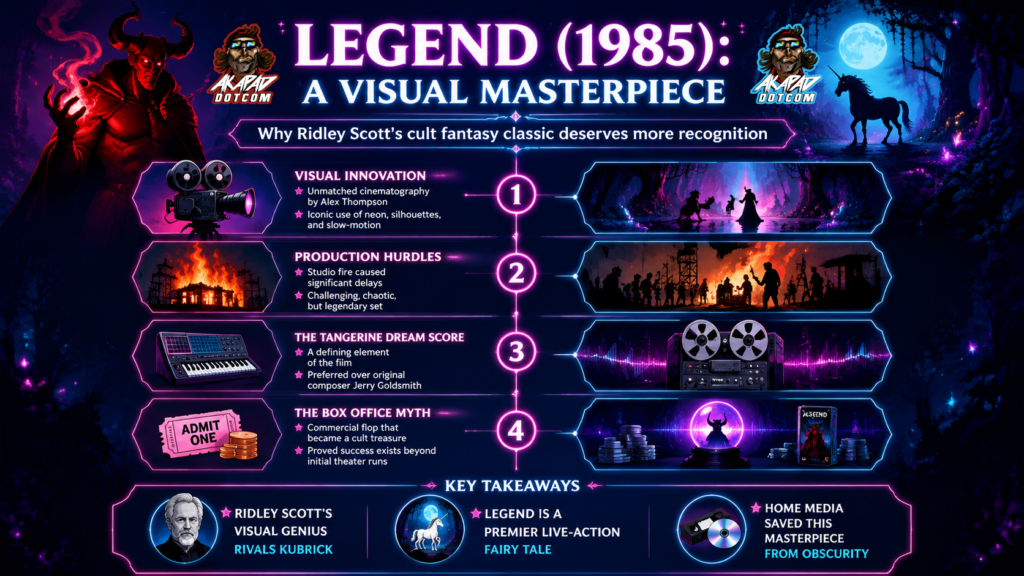
In this passionate Film Buff Review, I make the case why Legend deserves to be ranked among the all-time greats alongside films like The Dark Crystal. From its stunning cinematography and iconic practical effects, to the dreamy Tangerine Dream score, the production challenges (including the infamous Pinewood Studios fire), and Ridley Scott’s visionary direction — this is a deep dive into why Legend is far more than a cult curiosity. It’s a cinematic experience that still enchants and surprises.
Whether you’re a longtime fantasy fan, a Ridley Scott completist, or discovering the film for the first time, hit play on the podcast and prepare to see Legend in a whole new light.
[00:00:01]
Introduction to Legend (1985) and Ridley Scott’s Legacy
- The video opens with a focus on Legend (1985), directed by Ridley Scott, hailed as one of the greatest filmmakers of all time.
- The speaker expresses surprise and frustration that Legend has not gained recognition as one of the greatest fantasy or live-action fairy tale films.
- Despite Tom Cruise’s presence often overshadowing the film, the speaker strongly advocates for its artistic and cinematic value.
- Ridley Scott’s enduring career is noted, with a comparison to Woody Allen’s longevity.
[00:00:42]
Why Legend Hasn’t Achieved Greater Recognition
- The speaker questions why Legend hasn’t surfaced as a classic fantasy or fairy tale film despite its qualities.
- The film’s reception and legacy are contrasted with other fantasy films, suggesting it is underrated.
- The podcast welcomes viewers and emphasizes the personal viewing experience that motivated this discussion.
[00:01:20]
Controversy Around the Film’s Score and Multiple Cuts
- The original DVD double-disc release of Legend included multiple versions of the film and sparked debate about its musical score.
- Two main composers are mentioned: Tangerine Dream and Jerry Goldsmith.
- The speaker favors Tangerine Dream’s score over Goldsmith’s and supports the producers’ decision to emphasize Tangerine Dream’s work.
- There are at least two or three known cuts: theatrical, director’s, and European versions.
- The speaker recommends watching the theatrical cut with Tangerine Dream’s score to preserve the intended experience.
[00:02:01]
Comparisons with Blade Runner and the Role of Narration
- The film Legend is compared to Blade Runner in terms of critical debate and multiple versions.
- Blade Runner’s narration is criticized as necessary for understanding, implying a narrative weakness, whereas Legend is praised for its visual storytelling without needing explanation.
- The speaker stresses the importance of original cuts over extended or altered versions, citing Superman (Donner, 1978) as an example of a longer cut that diminishes the film’s pacing and impact.
[00:03:58]
Ridley Scott’s Career Trajectory Post-Legend
- After Legend, Ridley Scott faced a period called “director prison,” where he was less prolific or less celebrated.
- Films like Someone to Watch Over Me (1987) and Black Rain (1989) are mentioned as overlooked but quality works.
- Black Rain was a commercial success ($130 million gross on a $30 million budget), whereas Legend only broke even.
- Scott’s comeback began with Thelma & Louise (1991), which became iconic despite modest box office returns compared to Black Rain.
- His 1992 film about Christopher Columbus failed commercially but featured a memorable score by Vangelis.
- Later films such as Gladiator, Hannibal, Black Hawk Down, and Kingdom of Heaven established Scott as a respected Oscar-contending filmmaker.
[00:05:55]
Production Challenges and Visual Style of Legend
- The video discusses the documentary included in the two-disc DVD release, revealing production difficulties such as a devastating fire at Pinewood Studios that destroyed film sets during Legend’s shoot.
- Despite the chaotic production and increased budget, the film exhibits Ridley Scott’s visionary visual style.
- Scott’s desire for specific aesthetic elements is highlighted: neon lighting on the devil character (called Darkness), slow motion shots, snow effects, and realistic animal movement.
- The film’s cinematography by Alex Thomson is praised for its beauty and technical achievement, elevating the film’s visual impact.
[00:07:52]
Ridley Scott’s Visual Mastery and Cinematic Influence
- The speaker emphasizes Scott’s ability to create iconic, memorable shots across his filmography, comparing him favorably to Stanley Kubrick in terms of visual storytelling.
- Although Kubrick is credited with pioneering “memeable” and clip-worthy shots, Scott’s work on Legend and other films deserves equal recognition.
- The speaker references Scott’s continued admiration for Prometheus (2012), highlighting its visual richness and importance in his rotation of favorite films.
[00:09:22]
Artistic and Technical Merits of Legend
- Legend is described as a modern fairy tale with themes of lost innocence.
- Tom Cruise and Mia Sara’s performances receive strong praise.
- The film showcases some of the best movie makeup of all time.
- Tangerine Dream’s score is lauded as one of their finest works.
- Alex Thomson’s cinematography is reaffirmed as a major asset.
[00:10:03]
Box Office Performance and Industry Context
- The film was a financial disappointment, failing to meet its expected $100 million revenue despite a $25 million budget.
- Cinematographers like Alex Thomson are noted as rarely held accountable for a film’s failure, unlike directors.
- Thomson’s career includes notable films like Labyrinth, Alien 3, Cliffhanger, Demolition Man, and Kenneth Branagh’s Hamlet, affirming his expertise.
- The producer, Aaron Mitchell, is highlighted for his significant filmography: starting with The King of Comedy (1982), producing Brazil (1985), and Legend—all visually ambitious but commercially underwhelming films.
- Mitchell’s later career includes diverse titles such as The War of the Roses, Dangerous Beauty, and Tigerland, with variable box office success.
[00:11:41]
The Business of Filmmaking Beyond Box Office
- The speaker outlines the complex nature of film financing and profitability beyond theatrical receipts.
- Home video (VHS), cable, and international distribution provide additional revenue streams that can offset initial box office failures.
- The example of Regency, the production company associated with Mitchell, shows how producers maintain relevance and profitability through multiple projects and distribution deals.
- The box office is described as an imperfect measure of a film’s success or a producer’s career longevity.
[00:14:01]
Legacy and Conclusion on Legend and Its Cast & Crew
- Despite its commercial failure, Legend is seen as a remarkable showcase for everyone involved, especially Tom Cruise.
- The speaker shares a personal emotional response to re-watching the film, affirming its artistic and cinematic value.
- Legend is positioned alongside The Dark Crystal as one of the greatest fantasy films ever made.
- The video closes with a call to engage with the podcast through comments, likes, and reviews to help increase its reach, emphasizing the community aspect of film appreciation.
Key Quantitative Data Table
| Film/Project | Budget (approx.) | Box Office Gross (approx.) | Notes |
|---|---|---|---|
| Legend (1985) | $25 million | ~$25 million (break-even) | Mixed cuts, Tangerine Dream score |
| Black Rain (1989) | $30 million | $130 million | Commercial success |
| Someone to Watch Over Me (1987) | Not specified | Breaks even | Neon noir film |
| Christopher Columbus (1992) | $50 million | $7 million | Commercial failure, Vangelis score |
| Thelma & Louise (1991) | Not specified | Moderate box office | Iconic film, critical acclaim |
| The King of Comedy (Produced by Aaron Mitchell) | $20 million | $3 million | Underrated film |
Summary of Core Concepts and Insights
- Ridley Scott’s Legend (1985) is an underappreciated fantasy film with exceptional visual and musical elements.
- Multiple versions and score controversies have complicated its reception; Tangerine Dream’s soundtrack is preferred.
- Ridley Scott’s directorial style is marked by meticulous visual storytelling, often prioritizing mood and atmosphere over exposition.
- Production challenges, including a major fire at Pinewood Studios, contributed to the film’s troubled history.
- Although a box office disappointment, Legend is artistically significant and serves as a pivotal point in Scott’s career.
- Cinematographer Alex Thomson and producer Aaron Mitchell both have notable careers with films that are artistically ambitious but not always commercially successful.
- The film industry’s economics are complex, with home video and distribution deals mitigating theatrical failures.
- Legend’s legacy endures through its artistic merits, performances, makeup, and score, placing it among the best fantasy films alongside The Dark Crystal.
Keywords
- Ridley Scott
- Legend (1985)
- Tangerine Dream score
- Film cuts (theatrical, director’s, European)
- Cinematography (Alex Thomson)
- Production challenges (Pinewood Studios fire)
- Box office vs. artistic success
- Fantasy films
- Aaron Mitchell (producer)
- Visual storytelling
- Film legacy and cult status
00:00:01
Quiet on the set. >> Speed down. Production stage one. Action. >> There’s There’s something to where you watch a movie. My AK Patterers. 1985 Legend by the greatest filmmaker of all time, Ridley Scott. Uh, he’s still going. What’s he 90 right now? This is like as old as Woody Allen. And these two guys, what a with their individually toward the force each. You watch a movie like this and you say to yourself, where’s the right like the where’s the love for this
00:00:42
movie? How come Legend hasn’t surfaced as one of the greatest fantasy movies of all time? Why hasn’t Legend surfaced as the greatest liveaction fairy tale? Why hasn’t it surfaced as the greatest original film liveaction fairy tale? And it just seems like people say, “Oh, the Tom Cruz movie.” And they blow it off and I get pissed cuz I watched this movie. If you guys And guys, welcome back. If you haven’t guessed, I recently watched this movie. Welcome back, guys. The Film Buff Podcast.
00:01:20
Subscribe. Support. Give me a comment. I need someone I love. [snorts] You watch this and I go through right like we kind of know Ridley Scott rebounds from this movie. This movie also the original DVD double disc release which I believe had the uh right like there’s always been controversy with the score Tangerine Dream or Jerry Goldsmith. Tangerine Dream in my view like this is one of the only times I’ll say put Goldmith to the side. Tangerine Dream and there’s there’s controversy on that.
00:02:01
Go with Tangerine when just do it. I think that our producers and our executives have made a decision made the right decision. There’s maybe two cuts, maybe three cuts. There’s theatrical director’s cut, European cut. Oh my god. Just watch the normal. This is a lot like Bladeunner by AK Patter. And I really feel like the cinnaphiles, the the journalists, if you will, some of these people out there, not me, throughout the years, they really there was like a push at one time to make Legend 1985
00:02:42
debatable the way that Bladeunner became debatable. Give me Harrison Ford. Give me the narration. Please explain to me what’s happening because without the narration, you don’t know what the hell is going on in Bladeunner. It’s a failure. Legend, straight theatrical release. Tangerine Dream. Moving on. It doesn’t either of those two movies changed with these infinite cuts. By the way, guys, I remember when I first watched the Superman. I guess we’re talking about this. This the Donner Superman 1978
00:03:21
original cut 1977. The one that uh ABC, one of the cable guys or regular network guys, they added scenes so they can get like a threehour broadcast out of it. I finally saw that around. We didn’t talk about it. Saw it. sat down to watch it this past July. It’s like, yes, three hours of this movie and I’m watching it. I’m just saying. I’m like, no, just I need the original. It just makes way more sense. It moves way better. I’m just connected to it. I can’t connect with
00:03:58
this. It’s just too long. I don’t need to see everything. Editors exist for reasons. Final Cut rights for the creators and the executives exist for a reason. So Ridley Scott post movie here. He gets put in director prison. He 1987. Someone to watch over me. The these are two movies no one discusses. I think they’re both good movies. Someone to watch over me is a great neon noor flick. 1989 black rain. Michael Douglas, right? He because he gets a little right. Someone to watch over me. 1987 a
00:04:34
little bit of success, right? Breaks even. Black Rain makes a 100 million over its budget 30 million to 130. Legend, let’s just go to Legend. Breaks even. So, right, he gets put, but then he comes back with Thelma and Louise. Iconic movie. Not as big as Black Rain, but it becomes iconic. And then then in 1992, Ridley Scott says, “This is what makes him so good, guys.” He says, “You what you guys need is Christopher Columbus.” And then Hollywood in all of its glory says, “You need competing
00:05:11
Christopher Columbus movies. His makes 7 million off off of 50 million.” Now, the score for that movie by Vangalis, holy crap, that’s a boner. So Ridley’s guy takes him a while to like form into Gladiator, Hannibal, Blackhawk Down, Matchstick Man, Kingdom of Heaven, one of the best period pieces of all time, right? But he becomes like an Oscar guy. Films get nominated, he wins a few, loses a few, right? All all that fun stuff. So to cycle back to the two disc DVD release which had like a clear cover
00:05:55
again. Let’s talk about the documentaries. We love the documentaries for some of these DVD releases there. I learned that during the production of this movie legend that uh Pinewood Studios I believe that that’s that’s where this was filmed. We are going from memory even though I got stuff right in front of me here. Let’s just talk. That’s what we do here guys. Let’s talk movies. >> [snorts] >> the studio burns down with the film sets. It doesn’t just burn. It It burns
00:06:29
to the ground. So, the movie got this reputation. The budget kind of goes up. It’s a uh chaotic production, but you watch this movie and you really have to say by this point like does Ridley Scott just say he wants like does he have a way to communicate unlike any filmmaker we’ve seen? Does he just say, “Look, I want neon at the end of I want the devil to glow neon.” They call him darkness in this movie. Look, I want there to be silhouettes and the black light, and we’re going to
00:07:12
shoot it in slow motion, but there’s going to be snow falling. Look, guys, I want the unicorns and the horses to look this way when they run through the ravine. I want a little bit of water splash, please. Right. And he gets these shots in this movie. [laughter and gasps] I mean, it He’s got he’s got enough shots between Bladeunner and Alien to make anyone instantly jealous. Like your head spins. I mean, he gets that slow motion death scene. Michael Douglas’s partner in Black Rain,
00:07:52
too. The ending of Thelman Louise, the monologue, and the way he shoots Brad Pitt and Felman Louise. He gets the stuff, guys. Visually, no one no one competes with you. You You can say no one compete with the eye of Stanley Cubri. You can say that. And there’s all of this mumbo jumbo out there about that. Did Stanley Kubri give us shots? Did he give us clippable and memeable things, memeable things today that are echoed? Yes. But it’s a failure of film criticism not to put Ridley Scott right with Mr.
00:08:33
Cubri. And we’re just talking about his silly fantasy movies. I mean, every single one of his movies has has this. By the way, guys, I mean, that’s one of the reasons I I watch Prometheus as much as as I do. Prometheus has not left my rotation since I first saw that movie. That was back in 2012. That was one of the last movies I rushed to go see outside of Infinity War. So, we get this modernday fairy tale that is a complete orgy on the eye. We get this concept of lost innocence early. Tom Cruz is amazing.
00:09:22
Mia Sarah is amazing. We got some of the best movie makeup of all time. We got one of the best scores, Tangerine Dream of all time. Visually, Alex Thompson. So, this is where you watch this movie and let’s just say, you know, this movie was a disaster, right? Because they wanted a hundred million. They wanted $100 million from this movie. Cost 25 million. And you go, right, we were saying this earlier. We know Ridley Scott goes into director prison, comes out of it pretty well. Alex Thompson, this is our
00:10:03
cinematographer. Cinematographers are not held to standards on a film’s failure the way directors are. But yeah, this guy gave us Labyrinth to the Sicilian track 29. Let’s go. Oh jeez. Mr. Destiny, Alien 3, cliffhanger demolition man. Like we Oh my god. He’s the guy that did Kenneth Brana’s Hamlet. So he’s fine. But then, you know, you get a little concerned about the the producer. [laughter] Producer is fine. Where’s he at? Let’s talk about Aaron Mitchell. Geez, what a filmography legend. So, he
00:10:58
does the king of comedy. That’s his first film. Yeah, that’s a movie that they mind for the Joker. One score says he’s most underrated still at this point. 85 he produces Brazil and Legend. Two of the most visual movies in Hollywood history. Both through Universal. Both are flops, right? How much? What does Universal do? 10 off of 15. Legend breaks even. King of Comedy is three off of 20 million. It’s amazing. This is where you say, “Thank God for the home mark for the home VHS market. Thank God for
00:11:41
cable, you know, like just additional cash flow outside of theatrical releases. This is early 80s, guys. But but he go he he goes on. What does he do after the legend? The War of the Roses, Dangerous Beauty, Tiger Land. Oh, Joel Schumacher. We love that movie. Don’t say a word. Black Knight with Martin uh what? Martin Lawrence, High Crimes, Life or something like it. Oh, we I just watched that recently. I do like Life or something like it. But he really doesn’t find that insane success.
00:12:23
But it goes to show you that there is I mean he makes money with Jumper Doug Leman 85 million 225. [snorts] Wow. Oh yeah. Gone girl 60. So, it takes him his whole career to get a string of super hits or just movies that popped, but it goes to show you the business of Hollywood where you can fumble in what you’re doing. It cannot be perfect. It can be scattered. Yeah. I mean just he just regular production for gez Universal and Warner Brothers LA Confidential. I mean this guy’s an absolute industry of his own. But there
00:13:18
there’s money to be made. Regency International Alory Enterprise New Regency. This is a Regency guy. So when whenever you see a Regency logo, it’s him. But there’s money to be made outside of the box office. There’s distribution deals around the world to cut to cut people in on. So, it’s a real business. It’s not just the box office. The box office is a very weird equation when it comes to producer success. But what I’m trying to outline here is everyone comes out of this movie very
00:14:01
well. This movie is a box office dud if you want to call it that. It’s a disappointment, but it is a great centerpiece, great show showcase for everyone involved. Everyone involved, including our bully Tom Cruz goes above and beyond. And that’s man, there’s I just recently watching this AK Patter, it it just shook me. I it hit me how amazing and awesome of a movie this is. I’ve been saying that for a long time too, but I feel like I had the film experience, a film going experience
00:14:41
where I believe my own words. [laughter] I believe my own words enough. Uh this is Yeah. I mean, you can put this movie fantasy wise up against anything. I would say maybe uh Dark Crystal and Legend are the two greatest fantasy movies ever. All right, AKA Pow. I love you guys. Rock and roll. >> Roll sound. >> Sound production take two. >> Cut in. Sorry. Aka Powders. I know it’s such a hot passionate episode, but I’m breaking I’m breaking the flow real quick. Just to remind you guys, if you
00:15:17
want to support me, one of the best, easiest, and free ways to do it, leave a comment. Give me a like. I know there’s someone out there that you know that loves film as much as I do, that love the film industry as much as I show this to them. Comments, likes, and reviews, positive or negative, it doesn’t matter. We need to increase our reach. And to do that requires you your involvement in everything that I do. We’re we’re linked. We’re forever bound. You’re the membrane. I’m the muscle. So guys, let’s
00:15:57
just do it. One review. Do you have it in you? Okay. Back to the show. Okay, that’s a wrap.

AKAPAD is a versatile thinker known across Philadelphia, Europe, and even in the vast Multiverse as The Electic One. By day, he excels as an IT Mastermind, assisting individuals, both big and small, with a wide range of simple and complex solutions. In contrast, he is also a talented illustrator, a passionate comic book enthusiast, a creative content creator, and an active live streamer. Additionally, his podcast, “AKAPAD The Film Buff Podcast,” boasts an impressive catalog of over 500 episodes available on nearly every major platform.