 SIGN UP NOW FOR YOUR FREE TRADING CARD
How I Fell for the Moleskine Hemingway Myth: A Confession on Marketing Lies and Better Note-Taking with Moleskine
- Posted by PETER A DELUCA AKAPD
- On March 9, 2026
- 2026, article, ernest hemmingway, moleskine

I will admit it: I started using Moleskines through a lie—one I wasn’t totally familiar with because that lie was… marketing. To push shit. Because already I am crying on the altar, admitting how naïve and desperate I was at one stage in my life to be original.
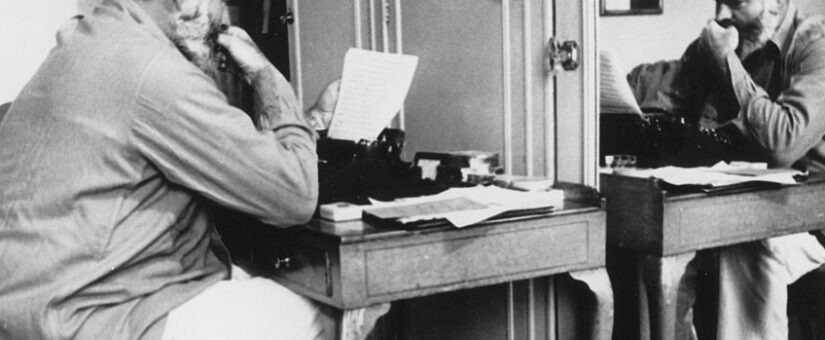
I believed that Ernest Hemingway, in the fields of battle, in whiskey-soaked nights, in the grit of it all, used a Moleskine to record his thoughts—and what valuable thoughts they were, for they ended up in some of the greatest novels of all time. For Whom the Bell Tolls, anyone?

The thought of this man caught in the turmoil of the world, living the type of life that became his page, could not have gotten to a typewriter without a Moleskine there. It was electric. At this time, whatever year it was, it seemed like providence that I read about this when I did. The tragedy—I do not remember where, most likely Esquire, my assumption since I was a heavy reader of the magazine back then (now, writing this, I regret letting the magazine go).
But here’s the thing: the Hemingway story was strictly marketing. Pure brand myth. Hemingway never used a Moleskine—those notebooks didn’t even exist in their modern form during his lifetime. The company cleverly wove his legend into their advertising to sell the idea of genius captured in their little black books. I fell for it completely.
The piece of this story that resonated was simple. It was not that he kept a notebook (I know, Moleskine). It was not that he used his notes to capture moments in life the way we use our smartphones—I was already doing that. Even at this time, I had what seemed like an endless supply of notebooks that I regularly kept for all the same reasons—some of which are found on this site in their entirety, as Hemingway. It was that he stuck to a format, and through that format, sure, all its order—everything stemmed from there.
He chose how he would do something and stuck to it.
Sounds simple, but sometimes you need a really good example—even if the example turns out to be bullshit—to see the value of something simple, and this was it.
From here, I adopted the Moleskine as a carry-around, catch-everything notebook where every thought, idea, inspiration, and hope was recorded in a uniformed manner—within the usual chaotic note-keeping I utilize to track my thoughts.
What came through this, though, was an understanding and practice of the process. Through my IT work, I was able to see processes become systems and how, with every task, a system could be formed. With this, the Moleskine became my everyday tool—for IT processes as much as for creative ones. I started to record my thoughts in a more organized manner. One could say the Moleskine became a weapon that enabled me to pre-rehearse my ideas and have them far more polished by the time I approached them for a final draft.

AKAPAD is a versatile thinker known across Philadelphia, Europe, and even in the vast Multiverse as The Electic One. By day, he excels as an IT Mastermind, assisting individuals, both big and small, with a wide range of simple and complex solutions. In contrast, he is also a talented illustrator, a passionate comic book enthusiast, a creative content creator, and an active live streamer. Additionally, his podcast, “AKAPAD The Film Buff Podcast,” boasts an impressive catalog of over 500 episodes available on nearly every major platform.