 SIGN UP NOW FOR YOUR FREE TRADING CARD

Warlock Home Video and the Shot-on-Video Horror Legacy of Chris Seaver
- Posted by PETER A DELUCA AKAPD
- On October 26, 2026
- 2026, article, chris seaver, warlock home video
Fellow film buffers, let’s talk about one of the purest, strangest corners of horror filmmaking that still refuses to die: the shot-on-video (SOV) scene. Not the polished indie horror that gets festival laurel stamps and streaming algorithms. The backyard stuff. The friends-with-camcorders stuff. The “we made this on a weekend with a case of beer and a plastic mask” stuff. Chris Seaver and the world he built around Low Budget Pictures, then Warlock Home Video, sit right in the middle of that.
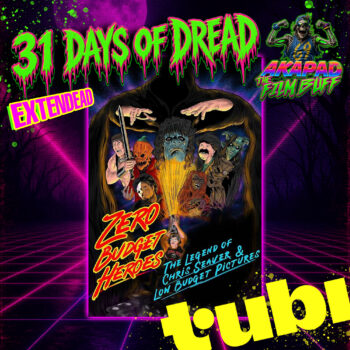
I recently spent time with the documentary Zero Budget Heroes: The Legend of Chris Seaver & Low Budget Pictures (available free on Tubi), and it sent me back down the rabbit hole of Seaver’s output. What struck me again—especially coming from Philadelphia and my own South Jersey roots in comics shops, local talent, and people who just wanted to make things—is how little of this work was ever about chasing legitimacy. It was about the crew. The jokes. The deliberate crudeness. The refusal to grow up on anyone else’s timeline.
From Low Budget Pictures to the Crypt
Seaver started early. By the early ’90s he had formalized Low Budget Pictures (LBP), the Rochester-based outfit that cranked out microbudget horror-comedies with titles like Mulva: Zombie Ass Kicker, Filthy McNasty, Anal Paprika, Scrotal Vengeance, and the various adventures of Teen Ape—the foul-mouthed, pimp-adjacent ape man who became one of the company’s most enduring characters. These were friendship-driven “crapsterpieces.” Same core people showing up, improvising, pushing limits, and not worrying much about whether anyone outside their circle would ever see it.
LBP ran hard for roughly two decades before Seaver shut it down around 2011 and launched Warlock Home Video. The new label mixed re-releases of older SOV titles (both his and others) with new retro-styled films, available on DVD and—critically—VHS. That physical VHS commitment mattered. For a lot of us who grew up wandering the horror aisles of independent video stores, the cover art, the tape itself, and the ritual of sliding it into the VCR still carry weight that streaming never fully replaced.
Warlock leaned into the aesthetic: hooded “Warlock” branding, strong box art, and a catalog that included everything from reissued oddities like Evil Night, Death Metal Zombies, and Amerikill to newer or newly packaged titles such as Death O’Lantern, Die-B-Que, Happy Helladays, The Dingleberrys, Sexsquatch, and more. The tone stayed consistent—over-the-top, often juvenile, deliberately low-rent, and packed with backyard gore, weird characters, and horror references.
The Films and the Feeling
What holds up isn’t technical polish. It’s the specificity. Evil Night gives you the classic nerd-revenge setup with a clown-masked killer and backyard splatter. Death Metal Zombies throws a Richard Nixon-masked killer, a satanic metal band, and flesh-eating converts into the mix. Sexsquatch (one of the early pure Warlock originals) leans hard into the absurdist, raunchy side with its horny Bigfoot-adjacent monster. Holiday entries like Happy Helladays and creature features like The Dingleberrys keep the same spirit: short, silly, mean in the way only SOV can be, and made by people who clearly liked making them together.
Seaver has long operated with a fictional “Warlock” persona—macabre, cryptic, and in on the joke. Early promotional material played with that character as the guiding force behind the label. It fits. These films never pretended to be respectable. They were for the people who already understood the joke.
Why This Still Matters
Seaver’s path is the opposite of the one that turns a microbudget success into a studio career. He stayed in the niche. The documentary makes that clear: the same core group of friends, the same willingness to make something ridiculous on almost no money, the same connection to the wider underground (including Troma’s orbit). For viewers who already live in that world—or who remember the VHS boom of DIY horror when camcorders got cheap—the appeal is obvious. For everyone else, it can look like high school. That’s part of the point.
In 2026 the catalog continues to surface. Titles appear on various streaming platforms, Seaver stays active with new projects and online content (including the It Crept From The 80s ecosystem), and physical releases still exist for collectors. The original impulse hasn’t changed: make the movie with the people around you, put it out, and don’t wait for permission.
If you’ve ever rented a stack of questionable VHS tapes on a Friday night, or if you’ve wondered what happened to the pure DIY strain of horror-comedy that never tried to clean itself up for a wider audience, Warlock Home Video and the larger Seaver catalog are still there. They’re not for everyone. They’re for the film buffers who already know why that matters.

AKAPAD is a versatile thinker known across Philadelphia, Europe, and even in the vast Multiverse as The Electic One. By day, he excels as an IT Mastermind, assisting individuals, both big and small, with a wide range of simple and complex solutions. In contrast, he is also a talented illustrator, a passionate comic book enthusiast, a creative content creator, and an active live streamer. Additionally, his podcast, “AKAPAD The Film Buff Podcast,” boasts an impressive catalog of over 500 episodes available on nearly every major platform.
0 Comments