 SIGN UP NOW FOR YOUR FREE TRADING CARD
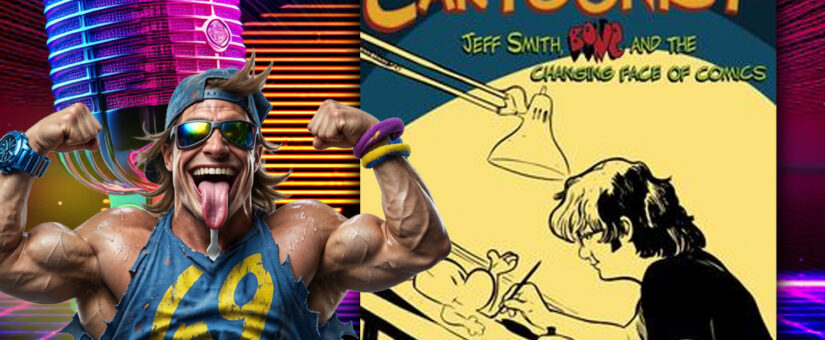
The Cartoonist: Jeff Smith, Bone and the Changing Face of Comics (2009) The Film Buff Review
- Posted by PETER A DELUCA AKAPD
- On September 5, 2026
- 2026, comic book documentary, documentary, jeff smith, podcast, talk
The Evolution of Comic Artistry: Jeff Smith, Bone, and the Landscape of Cartoonist Documentaries
Summary
This video discussion offers an insightful exploration of the 2009 documentary “The Cartoonist: Jeff Smith, Bone, and the Changing Face of Comics,” contextualizing it within the broader history of comic artist documentaries. The documentary, originally a limited and somewhat obscure DVD release, chronicles Jeff Smith’s journey creating Bone, a seminal black-and-white comic series that redefined the art and storytelling of cartoonists. The video reflects on how the role of a cartoonist differs fundamentally from other comic art professionals, emphasizing the unique multifaceted creative responsibility cartoonists take on—writing, drawing, lettering, and storytelling altogether.
The commentary traces the lineage of comic artist documentaries beginning with Robert Crumb’s Crumb (1994), then moving through intermittent projects until the more recent mainstream superhero-focused films such as Frank Miller’s American Genius. It positions Jeff Smith’s documentary as a pivotal work that highlights the challenges and sacrifices behind independent comic creation, such as the critical support from Smith’s wife and his struggles maintaining deadlines while growing his enterprise.
Further, the discussion offers personal reflections on the Bone series, including its ideal black-and-white format and reservations about its colorized editions. It also touches on the broader comic documentary landscape, underscoring a disparity between superhero creators and non-superhero cartoonists in documentary representation. Additionally, the video examines the sometimes contradictory nature of critical reception post-Bone, where Smith’s later works receive less acclaim compared to the foundational importance of Bone itself.
In closing, the video strongly recommends the documentary as essential viewing for understanding the American comic book experience beyond superheroes, spotlighting Jeff Smith’s artistry, business savvy, and the emotional sacrifices entailed in independent comic publishing.
Highlights
- 🎬 The Cartoonist documentary (2009) chronicles Jeff Smith’s creation of Bone, emphasizing the cartoonist’s multifaceted creative role.
- 📽️ The lineage of comic documentaries spans from Robert Crumb’s cult classic (1994) to recent superhero-focused films, revealing evolving public interest in comic creators.
- 💡 Jeff Smith’s wife played an essential role in the business and personal challenges during the rise of Bone.
- 🖤 Bone is best experienced in its original black-and-white format rather than colorized editions.
- 📺 Non-superhero comic creators receive significantly less documentary coverage compared to superhero artists.
- ✍️ Critics tend to both elevate and scrutinize artists post-success, with Jeff Smith’s later work seen as less impactful than Bone.
- ▶️ The documentary is freely accessible on YouTube, serving as a vital resource for comic arts enthusiasts.
Key Insights
- 🎨 The Complete Cartoonist: Jeff Smith embodies what it means to be a cartoonist, fulfilling every creative role—from scriptwriting to lettering—highlighting the uniqueness of cartooning versus fragmented comic production. This holistic approach intensifies the personal investment and creative control in comics like Bone.
- 📚 Documenting Comic History: The shift from niche VHS/DVD releases (e.g., Comic Book Confidential) to accessible, mainstream documentaries (e.g., Frank Miller’s American Genius) parallels the evolving cultural recognition of comics from subculture artifacts to respected art forms.
- 🕰️ Timing and Legacy: The documentary’s release near the conclusion of Bone’s original run captures a critical transitional moment when Jeff Smith’s work moved from underground acclaim to mainstream commercial success via Scholastic, illustrating the complex lifecycle of independent comic projects.
- ❤️ Support Systems Behind Success: The film’s emphasis on Smith’s wife’s sacrifices shines light on the often-hidden personal and familial dynamics essential to sustaining long-term creative endeavors, reminding viewers that success in arts industries is rarely solitary.
- ⚫ Preserving Artistic Integrity: There is a strong argument made for retaining the black-and-white presentation of Bone, respecting the artistic vision and aesthetic that contributed to its storytelling power. This caution against colorization reflects wider debates over artistic authenticity versus commercial adaptation.
- 🤝 Underrepresentation of Non-Superhero Creators: The contrast between abundant superhero documentaries and scarce ones about independent or alternative creators like Smith, Spiegelman, and Crumb reveals a gap in mainstream comic historiography, potentially shaping public perceptions of the medium.
- 🧐 Critical Reevaluation Over Time: Post-Bone, Jeff Smith’s later projects face a more tempered reception, illustrating the volatility and expectations placed on creators once a seminal work defines their legacy. This dynamic also exposes patterns of favoritism and fluctuating critical support within comic journalism and fandom cultures.
Here is the transcript of the AKAPAD The Film Buff review of The Cartoonist the Jeff Smith Documentary.
00:00:01
Quiet on the set. >> Camera speed, sound production, take one. >> Action. >> It’s the weekend, my fellow cartoon watchers. >> Who’s talking? >> The cartoonist, Jeff Smith. Excuse me, guys. I’m getting some iced coffee. 2009 is when this documentary dropped. Originally, it was it was it was only DVD. And you kind of It was a little bit one of those things where after a few years passed, you have to you had to have known a guy to find this DVD. A couple years go by. So, right like
00:00:42
2009 2000 like 19, right? Like you go ahead like 10 years and no one remembers this freaking thing. And what we’ve had since this documentary, we’ve had this like explosion of uh in my view, right? Like the understanding of what a cartoonist is. A cartoonist writes, draws, letters, and they create the cartoon. That like they are a cartoonist. They’re not a comic book illustrator, colorist, inker, penciler, writer. They do it all. They’re like a one-stop shop. That’s a cartoonist.
00:01:20
So, if we go back, 1994, Crumb. Boy, I love talking about this. But, I I was just watching this again too recently. Crumb. Robert Crumb. Documentary that that kind of sets the world on fire. Makes R. Crumb, Robert Crumb. And my apologies if you go back and listen to the uh my episode on on on Crumb. I I might have called him Roger Crumb a few times. I think Roger Crumb is a way better name than Robert Crumb. Come at me, bro. So, between ’94 and 2009, there there was roughly like the this is your your two major
00:02:06
comic book or cartoonist or illustrator but the world of comics documentaries. There was a couple there’s one called Comic Book Confidential. There were a few other that hovered around and then there was the Comic Book Greats VHS series. >> [snorts] >> But it wasn’t until recently where we got a couple weeks ago I did Frank Miller the I think it’s the American dream. Or the American genius Frank Miller. We spoke about that documentary. That’s the first a true mainstream
00:02:41
documentary of a comic book talent that was superhero focused. Now, in the past we’ve had like Superman documentaries that talked about Siegel and Shuster. We’ve had Batman documentaries that discussed Bob Kane. Even Bill Finger the I don’t I don’t buy any of it but he’s somewhat now the co-creator of Batman. I think this is one of the biggest travesties in modern journalism especially comic book journalism which comic book journalism doesn’t have a lot to stand on by the way
00:03:17
[snorts] >> in my personal opinion. Bill Finger has a documentary but that’s more about the docu- that documentary is more of a docu- documentation of how this guy e-begged his way into getting Bill Finger credit for for Batman. It’s it’s it’s a travesty. It’s called like Bill and me or Billy and me. It’s whatever. I refuse to have any of it. That’s the most airtime that Al Gore will get from me. So, the cartoonist recently >> I started listening to it on my way home
00:03:50
from work. I was so excited. It’s really weird Like, you know like sometimes you randomly look at your phone and you just see something and you almost like your your jaw drops. I do it sometimes with some eBay listings when something becomes available. So, I put this on immediately. I have about a 25-minute walk home. And on my way home, yeah, I’m getting the history like I don’t know too much of I know like some of cuz I’ve read interviews, but yeah, like I’m recalling some of the the get-upsmanship of
00:04:25
Jeff Smith where no one would buy the cartoon. Uh he loved Pogo, which is now like another forgotten cartoon. Yeah, like and how he kind of would develop this like animation style for the character. But then we get into I love it when we get into the weeds and we find out like how much his wife sacrificed and gave up and and helped him like run the company and how important and and relying he was on keeping deadlines and knowing he would have to miss deadlines cuz the book was growing in popularity and he had a
00:05:01
business to run. So, all these things. So, I get home, start it over on YouTube, and I’m literally sketching at my drawing desk as as this thing runs. Here was my biggest revelation. This documentary was 2009. I thought this documentary was maybe 2006, 2007. I thought this documentary came out roughly during the middle of the Bone run, but this documentary was released somewhat in conjunction to him wrapping up the Bone regular monthly series. 55 issues, thousand-plus pages. It’s now available. They call it the Bone Bible
00:05:43
or like the Bone phone book. And you can buy the complete story, like for about 25, 30 something dollars, you get it all. And you can get it in the glorious black and white. The other little thing I would So, I I misremembered when this thing came out. I remember being at 10D in Washington Township, New Jersey. And he had like one or two of these DVDs. And I want to say they were maybe like 35, 45. They were DVDs like this or documentaries like this at one time, but they were always priced through the roof.
00:06:19
And he had it behind the counter, a little bit of it like DVD shelf/easel. And whenever I was there, I was just checking on the documentary to see if it like the price lowered dropped or like he never had like a clearance sec- section. And then a couple years go by and I would say a few years ago, my buddy Mark I I brought this up to him. I asked him if he ever saw it. It might have been around the time that he saw Frank Miller American Genius in theaters. Like he’s he’s that much of a die hard. I love it.
00:06:50
And I want to say he had not seen this. And now since then, I discovered it’s called a beautiful disaster, the Art Spiegelman documentary, the creator of Maus, which is heavily referenced in this documentary as well. I had no idea. And so now we can like intersect two of these documentaries. The one of the minds behind Bone’s evolution to go to Scholastic and get colorized uh came from a conversation he had with Jeff Smith to where Bone is like a colorful world, Maus is black and white jewelry, uh it’s it’s you know, a
00:07:29
slice of the the worst kind, but it is a slice of life. It’s semi-autobiographical or biographical based on like uh conversations he had with his his father. So, we get a little bit of insight into what I always felt like was a travesty, colorizing Bone. Bone, in my view, was envisioned as a black and white comic. Uh it should always remain as a black and white comic. And I will forever say it should only be a black and white comic. I don’t even like the what they call the Bone phone book. I’m very much
00:08:05
into the individual trades. And reading Bone, I’ll tell you like it’s it’s a unique comic book reading experience. And this documentary pulls in enough of you know, things we expect. Uh contemporaries, people within the the industry, the business. And they all just uh stroke this guy off, right? They all love him. He’s never done anything wrong. Uh all quick side note, on my YouTube channel, look up Jeff Smith Shazam. And you’ll find my reaction to his Shazam mini-series, uh which I review in the
00:08:42
from a hardback hard cover. It’s a reprint. Deluxe size. I I want to say it’s deluxe size. Feel free to fact check me on that. And you will see uh what you know, a disconnect. So, this guy, like he’s Jeff Smith is an illustration and storytelling genius, but at the same time, uh his sensibilities don’t lend themselves to everything all the time. Where in and like it I think the the path I’m trying to to pave here real quick for you is is a lot of times creators are in a sweet spot, and even
00:09:21
the critics don’t realize it because he they move on to the next thing, and the next thing needs to be as great as the previous thing. And as a critic, and you just even as like a part-time commentator, so on and so forth, you can take a position a lot of times when you look out of work. You you can give it adulation or you you you kind of see for what it is. And a lot of times critics it’s beneficial for them to go both ways sometimes. You know, like to have creators that they prop up and to have
00:09:52
works and other creators that they bring down. That’s a lot of times if you read enough of all of this stuff and you’re involved with it long enough you do see these patterns. Like you’ll see favoritism and all this other In my view, Jeff Smith is one of the guys that got a lot of favoritism post he left Bone and some of the items he worked on like Rascal for example. You know, like there these works are serviceable. They’re okay, but in no way are they of the magnitude and the I would say the
00:10:29
collective imagination that Bone represents. But this in my this like documentary I think it’s a must-watch. It’s available right now on YouTube and it expands what we understand about the American comic book reading experience and how and why. And it’s substantial cuz it’s not superhero hero related, which also lends itself to more of these document There’s so much more out there of the non-superhero creators versus the superhero creators for example. I don’t know why that is outside of you know,
00:11:03
guys like Stanley. Stanley’s got like a dozen or so documentaries. But yeah, AK Powers the cartoonist Jeff Smith Bone. And the changing Wait, wait. Here here’s a Yeah, this is the full subtitle by the way. Let me read to you. The cartoonist Jeff Smith Bone and the changing face of comics 2009. It’s a full recommendation. This is the work I feel you should be aware of. I think it’s great that they captured the moment of the transition of Bone going full mainstream with Scholastic, wrapping up
00:11:38
the series. And like I said, everything with the wife I absolutely loved about this, to how much she just like supported them, gave up everything. They made a bet, and just you know, the the learning now, like the the trials and tribulations of managing success. It’s good stuff. I love you guys. Rock and roll. >> Okay, that’s a wrap.

AKAPAD is a versatile thinker known across Philadelphia, Europe, and even in the vast Multiverse as The Electic One. By day, he excels as an IT Mastermind, assisting individuals, both big and small, with a wide range of simple and complex solutions. In contrast, he is also a talented illustrator, a passionate comic book enthusiast, a creative content creator, and an active live streamer. Additionally, his podcast, “AKAPAD The Film Buff Podcast,” boasts an impressive catalog of over 500 episodes available on nearly every major platform.