 SIGN UP NOW FOR YOUR FREE TRADING CARD
KINGDOM OF HEAVEN (2005) – MY MOST WATCHED FILM OF THE YEAR
- Posted by PETER A DELUCA AKAPD
- On January 7, 2026
- 2026, best of 2025 film buff, drama, drama film, drama movie, drama movie podcast, drama podcast, historical movie podcast, podcast, ridley scott, talk
Welcome to the Film Buff Review of Kingdom of Heaven (2005) – My Most Watched Film of the Year!
In this enthusiastic and deeply personal episode, Peter A. DeLuca (AKAPAD) celebrates Ridley Scott’s epic medieval masterpiece as the film he watched more than any other in 2025. While many overlook or misunderstand the movie, AKAPAD makes a strong case for it as a true masterpiece — one of the most visually stunning, historically rich, and emotionally compelling historical epics ever made.
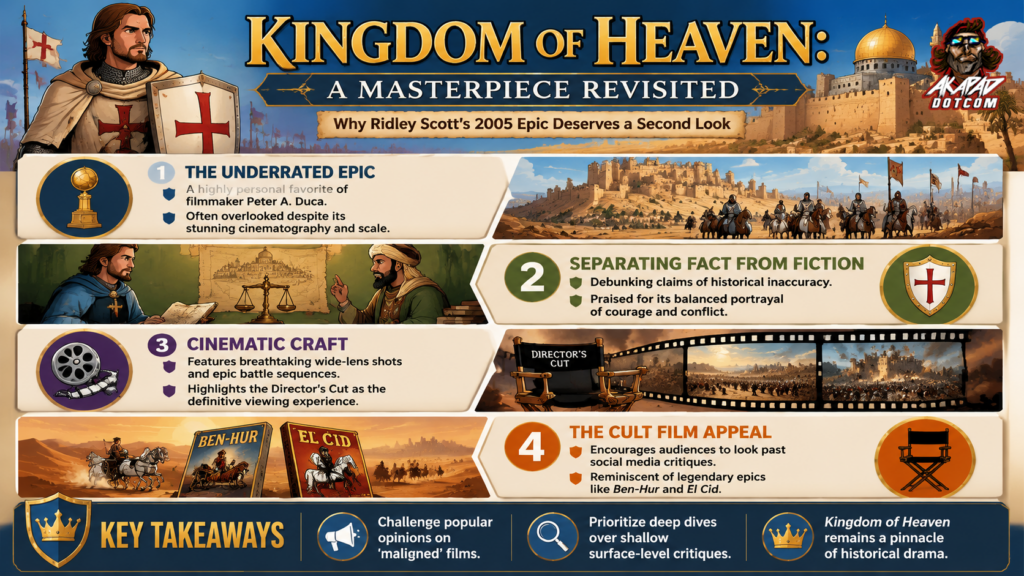
Orlando Bloom stars as Balian, a man who hits rock bottom and finds purpose defending Jerusalem during the Crusades. AKAPAD praises the jaw-dropping wide-lens cinematography by John Mathieson, Harry Gregson-Williams’ powerful score, the nuanced portrayal of courage and ruthlessness on all sides, and the film’s impressive historical accuracy. He strongly recommends the Director’s Cut (30–40 minutes longer) for its richer storytelling and depth.
AKAPAD also compares it favorably to other early-2000s historical epics like Troy and Alexander (ranking Kingdom of Heaven #1), addresses common criticisms, and laments how social media and shallow film discourse have caused this Ridley Scott gem to be unfairly dismissed. He places it in the grand tradition of classics like Ben-Hur, The Ten Commandments, and El Cid.
Crank up the volume, grab your sword, and ride into the Crusades with one of the most rewatchable epics of all time. Perfect listening during awards season or anytime you want to rediscover an underrated cinematic gem.
[00:00:01]
Introduction to Awards Season and Podcast Context
- The episode opens with an announcement about the first-ever awards season hosted by the podcast “The Film Buff,” signaling a new focus on awards discussions.
- Golden Globe nominations have just been released, prompting the host to plan a supplemental episode between Wednesday and Thursday to cover awards-related content.
- The host, Peter A. Duca, broadcasts from Center City, Philadelphia, expressing personal fondness for the city and excitement about presenting his own unique awards show.
[00:01:17]
Focus on Kingdom of Heaven (2005) as the Most Watched Film of the Year
- Peter highlights Kingdom of Heaven as his most watched movie of the year, surpassing even notable films like F1 and The Curious Case of Benjamin Button (referred to humorously as a Brad Pitt masterpiece).
- He praises multiple aspects of the film: music, cinematography, and storytelling.
- The film inspired Peter to simultaneously watch the movie and learn extensively about the historical Crusades, deepening his appreciation of the film’s context.
[00:01:56]
Common Criticisms and Misconceptions Addressed
- One criticism Peter mentions is the portrayal of Muslims as “geniuses” and defenders of their land, while Christians, Jews, and Israelites are depicted as buffoons. Peter rejects this interpretation, seeing instead a nuanced depiction of ruthlessness and courage on both sides.
- Another critique is about historical accuracy, with some labeling the film inaccurate. Peter argues the opposite: Kingdom of Heaven is one of the most historically accurate movies ever produced, especially regarding its wide lens cinematography and depiction of events.
[00:03:13]
Character Analysis and Historical Context
- Orlando Bloom’s character follows a classic narrative arc: hitting rock bottom and finding purpose through a crusade.
- Historically, the film is set at the end of the Second Crusade, leading into the Third Crusade, marked by shifting alliances aimed at reclaiming the Holy Land.
- The Muslim forces are depicted as a dominant military power, which aligns with historical accounts of the period.
- The film’s events emphasize alliances forming after the Second Crusade to oppose Muslim control.
[00:04:29]
Cinematography, Music, and Production Quality
- Peter praises the film’s visual and auditory elements, spotlighting cinematographer John Mathieson and composer Harry Gregson-Williams.
- The director’s cut, which runs 30 to 40 minutes longer than the theatrical release, is strongly recommended for its enhanced storytelling and depth.
- The film’s release period coincided with a trend of large-scale historical epics like Troy and Alexander, which targeted audiences who enjoyed grand war sagas such as The Lord of the Rings.
[00:05:07]
Comparison to Other Historical Epics
- Peter compares Kingdom of Heaven to other historical epics:
Movie Ranking by Peter A. Duca Notes
Kingdom of Heaven 1st (Best) Masterpiece, overlooked
Troy 2nd Serious historical saga
Alexander 3rd (Maligned but good) Oliver Stone’s film, underrated He emphasizes that Kingdom of Heaven stands out as the best among these, despite being underappreciated. [00:06:19] Critique of Contemporary Film Discourse- Peter criticizes modern film discussions as often superficial, emotionally driven, and shaped by social media influencers who dictate opinions.He laments the lack of in-depth conversation about a film’s intent and historical context, reducing complex works to low-effort, “low-hanging fruit” commentary.This trend damages the appreciation of film history and causes worthy movies like Kingdom of Heaven to be unfairly dismissed.
Argument for Re-Evaluation and Recognition- Peter calls for Kingdom of Heaven to be re-evaluated and placed high on everyone’s must-watch list, especially during awards seasons such as the Golden Globes and Oscars.He stresses that the film’s beauty, story, and historical richness deserve more attention and respect.The movie is described as visually stunning, violent, and emotionally compelling—a medieval period masterpiece on par with classics like Ben-Hur and Quo Vadis.
Legacy and Cinematic Lineage- The film is positioned as a modern answer to epic historical films such as The Ten Commandments, Ben-Hur, and El Cid.Peter suggests that today’s viewers and filmmakers benefit from the access and resources available to Ridley Scott in 2005, elevating Kingdom of Heaven as a contemporary landmark in epic filmmaking.
Personal Reflection and Closing Remarks- Peter expresses deep personal affection for Kingdom of Heaven, stating he frequently revisits the film.The movie inspired him to correct many misconceptions about the Crusades, highlighting the educational value of cinema.He ends by encouraging listeners to explore overlooked films in their own collections and to challenge prevailing narratives in film criticism.The episode closes with warm regards to his audience and excitement for continuing discussions in upcoming episodes.
- Kingdom of Heaven is a highly underrated and historically accurate epic directed by Ridley Scott.The film’s portrayal of the Crusades is nuanced, showing courage and ruthlessness on all sides rather than simplistic stereotypes.The director’s cut offers a richer experience and is strongly recommended.Compared to Troy and Alexander, Kingdom of Heaven stands out as the superior historical epic.Modern film criticism often lacks depth and is influenced by social media trends, which can harm the appreciation of complex films.Kingdom of Heaven deserves to be reappraised and honored within awards conversations.The film continues the legacy of classic historical epics, updated for modern audiences with advanced cinematography and storytelling.
- Ridley Scott – Director known for visually stunning and historically grounded films.Orlando Bloom – Actor portraying the protagonist who undergoes a transformative journey.Harry Gregson-Williams – Composer responsible for the film’s acclaimed score.Second and Third Crusades – Key historical periods covered by the film, involving shifts in alliances in the Holy Land.
00:00:01
Quiet on the set. >> Speed down production stage one action. >> For the first time ever, AK Powers, we’re doing our own awards season. Golden Globe nominations dropped today. Uh, by the way, be be on the lookout. I think I wanted to do a a quick rundown. So, we’re going to do a supplemental episode between Wednesday and and and and Thursday and Friday. Wednesday and Thursday. But it’s it’s coming soon. But it’s award season. For the first time ever on this podcast, the Film Buff
00:00:36
Podcast, Peter A. Duca coming to you from Philadelphia, PA. Center City, Philadelphia, the town I love. I love this city. So, for a lot of years, uh, I struggled with this. And we’re doing a awards show my way, and it just excites me. So, I know I was teasing the thriller. Uh, the thriller award will be the next episode. I said that at the end of our our previous episode, which was Good Boy, aka the best horror movie of the year. We’re [snorts] going to do one for you, one for me. This is Kingdom
00:01:17
of Heaven, 2005. This is my most my most watched movie of the year. Now, I watched a lot of F1, the the Brad Pitt masterpiece. Yeah, I I say masterpiece a little bit. Nudge nudge wink wink. But holy crap, I love the music for that movie. I love the way it’s shot. I love the story. But Kingdom of Heaven, uh there was just a couple weeks where I I was doing two things. I was watching this movie and then uh just endlessly learning about the Crusades. And I’ve long said that this is one of the most like overlooked movies that we
00:01:56
have period. It’s directed by Ridley Scott. It’s written by William Monahan. And we get two criticisms if we were to scratch this movie on the surface. And and by that I mean social media, Tik Tok, uh Facebook, Twitter. One of them is is that the Muslims in this movie are portrayed as geniuses and the well, everyone else defending their land against the Muslims. Uh, you know, the Christians, the the Jews, the Israelites. Uh, well, they’re buffoons. I I never got that from this movie. I
00:02:32
got I got one side being ruthless and one side being courageous. Uh, and that that kind of toggles between some of these characters. The other weird criticism is that this movie is not historically accurate. Aka Patter Kingdom of Heaven is one of the most historically accurate movies ever put onto a cellular ever broadcast to a giant screen. There’s shots in this movie, and we’re talking about the the wide lens stuff. It’s just jaw-dropping. uh Orlando Bloom’s character, his quest, which is like somewhat like very
00:03:13
similar to what we’ve seen in in other movies like like this this character kind of needs to go into destitude, needs to hit rock bottom, and then like he finds a purpose or in this case, he finds a crusade. And historically, this is the end I believe of the second crusade uh that leads into the third crusade. Uh because like the the Muslims were just uh you know like all in all just massive army uh kicking ass and well and and at this point I you know like and I I I may be getting my my crusade count wrong but what happens is
00:03:50
that there’s more of an alliance after this uh you know to to take back the holy lane like more kingdoms or and and more territories gather. So, uh, it’s it’s wild. But AK Paris, the way that this movie is shot, the way this movie is look, cinematography, John Mat, I love this. Henry Gregson Williams. This is our composer. There’s just so much to love about this movie. And what I prefer is there’s a director’s cut. I believe that’s 30 to 40 minutes longer than what came out theatrically. And
00:04:29
here’s the wild thing. When this movie came out, it kind of came out around I want to say like Troy and Alexander where historical like big army dramas were somewhat like in vogue and they were kind of positioned to compete alongside or with or against like or fall into the taste of the people that liked Lord of the Rings. this giant army stuff, the the things that they could do now with AR, you know, just with the special effects and and you can have armies that that stretched all the way into the horizon and it looked real.
00:05:07
This is what Peter Jackson and Lord of the Rings like unlocked. And along the way, we get kind of like these these serious stories, even Troy, like a very serious story, very serious saga that is embedded in in history. A lot of it too. Last sand. There’s Last Sand here. There’s Last Sand and Troy. There’s Last Sand in Alexander the Oliver Stone movie too. Now keep in mind these three movies are three fantastic movies. Kingdom of Heaven is the best of all of them. Troy number two, Alexander
00:05:40
number three, and Alexander 2 much maligned. But for for whatever reason, uh I think that movie too. Like these are Kingdom of Heaven is another masterpiece from Ridley Scott. It’s more of a masterpiece that it’s so perfectly overlooked and it’s a little bit of the like my fascination with this. And I implore like all of you to find something like this in your own filmography, your own go-to. You should have gotos that you know are maligned movies, movies that have been dragged through the mud.
00:06:19
And the best part about it is often you’re right, they’re wrong. That’s the best thing. A lot of film conversation today uh get set in stone and and it catches fire. Uh, and it’s it’s it’s even more evident today when we have more influencers that that kind of set the tone of what we’re supposed to believe and feel about movie. Uh, again, uh, no discussion about intent when we um when we review movies. So, we get these like very low-level platitude uh, you know, like surfaced and you
00:06:57
know, kind of like what what are we really talking about here? Maybe you’re saying that to yourself about this this episode, but we we get like unfocused, unthoughtout opinions and we just get this lowhanging fruit emotional like like barf and that’s really what it is. Now, it doesn’t mean through that that uh some of these reviewers and some of these conversations about movies are incorrect. Sometimes they’re right, sometimes they’re they’re wrong. But I’m just talking about like the overall
00:07:28
attitude of of this practice which is it it hurts film history. It really does. Kingdom of Heaven at this point should be at the top of everyone’s list as uh we were wrong about this movie. We overlooked this movie. Uh Oscar season, Golden Globe season, awards season overlook this movie. And I continuously go back to this film. Uh, and those are a lot of questions I ask myself as I’m watching this movie. It’s a beautiful story. It looks beautiful. It is bloody. It’s violent. Uh, it’s it’s just off the
00:08:04
chain. And Ridley Scott is making a medieval period masterpiece on the level of I’m going to say it. Ben her. I’m going to say it. Quovadus. You guys remember that. uh of Beckett and and like the the list goes on and on. There’s something to where even when we watch something like Ten Commandments and Ben her and we say to ourselves, man, like only today, what would this look like today? And Ridley Scott answered that. Even like what a movie like El Sid like you go there uh you sit down and you get your popcorn
00:08:45
you watch you watch El L Elsid and then you watch Kingdom Kingdom of Heaven and you will see a generation that grew up watching these movies and a generation that has the access that Ridley Scott did in 2005. Uh I’m sorry EK Powers. I I freaking love this movie. I’m grateful for it and yeah, I’m probably going to watch it tonight or tomorrow. I’m just, like I said, this movie’s been on repeat for quite some time and it it triggered me to learn and understand so much more about the Crusades where, you know,
00:09:18
without talking about history, I had a lot wrong with my understanding of that as well. All right, AK Packers, I love you. Rock and roll. Okay, that’s a wrap.

AKAPAD is a versatile thinker known across Philadelphia, Europe, and even in the vast Multiverse as The Electic One. By day, he excels as an IT Mastermind, assisting individuals, both big and small, with a wide range of simple and complex solutions. In contrast, he is also a talented illustrator, a passionate comic book enthusiast, a creative content creator, and an active live streamer. Additionally, his podcast, “AKAPAD The Film Buff Podcast,” boasts an impressive catalog of over 500 episodes available on nearly every major platform.

