 SIGN UP NOW FOR YOUR FREE TRADING CARD
HANNIBAL (2001) – THE 31 DAYS OF DREAD
- Posted by PETER A DELUCA AKAPD
- On October 28, 2024
- 2024, 31 days od dread, 31 days of dread 2024, 31 dod, horror, horror film, horror movie, horror movie podcast, podcast, ridley scott, talk
Welcome to the Film Buff Review of Hannibal (2001) – 31 Days of Dread!
In this chilling October episode, Peter A. DeLuca (AKAPAD) dives deep into Ridley Scott’s stylish and controversial sequel to The Silence of the Lambs. As part of his annual 31 Days of Dread horror marathon — the longest-running horror event in podcasting — AKAPAD celebrates Hannibal as a bold, atmospheric “banger” that puts the iconic cannibal front and center.
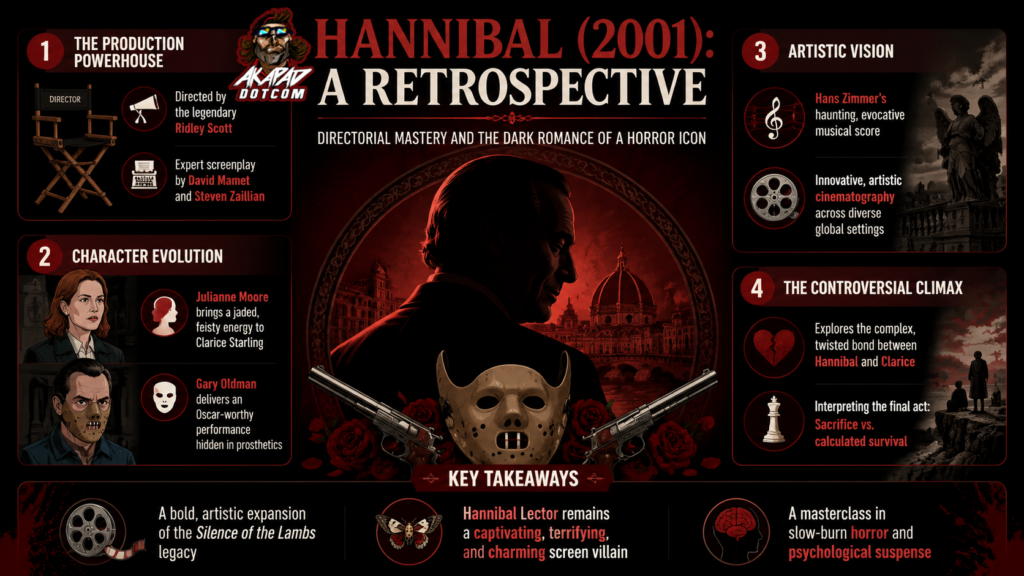
Starring Anthony Hopkins reprising his Oscar-winning role as the sophisticated Dr. Hannibal Lecter and Julianne Moore as a tougher, more jaded Clarice Starling, the film features a dream team: screenplay by David Mamet and Steven Zaillian, Hans Zimmer’s haunting score, and Ridley Scott’s signature visual flair (including Florence, Washington D.C., and those unforgettable wild boar scenes). AKAPAD explores the complex “cat-and-mouse” relationship between Hannibal and Clarice — a twisted dance that’s equal parts obsession, protection, and psychological tension — while defending the film’s controversial ending and Hannibal’s nuanced portrayal as both monster and charismatic anti-hero.
From franchise context and comparisons to the Thomas Harris novels to Ridley Scott’s masterful direction, this episode is packed with passionate analysis, hot takes on the Lecter legacy, and why this 2001 sequel still delivers gourmet thrills more than two decades later.
Dim the lights, pour a glass of Chianti, and sink your teeth into this gourmet horror-thriller. Perfect listening during spooky season or anytime you crave intelligent, stylish horror. Now streaming on the Film Buff Podcast.
[00:00:01]
Introduction to the Hannibal Franchise and Context of Hannibal (2001)
- The discussion begins with The Silence of the Lambs (1991), which became an Academy Award-winning film that launched the Hannibal Lecter franchise into widespread recognition.
- The Silence of the Lambs is the middle book in a trilogy by Thomas Harris, which includes Red Dragon (adapted twice, including Manhunter and Red Dragon films), The Silence of the Lambs, and Hannibal.
- Hannibal (2001) is notable as the first film in this series to place Hannibal Lecter front and center in the narrative.
- The film was directed by Ridley Scott, considered “the greatest filmmaker of all time” by the narrator, and attracted top Hollywood talent.
[00:00:43]
Overview of the 31 Days of Dread and Horror Film Passion
- The mention of Hannibal is part of the “31 Days of Dread,” a horror film podcast event occurring every October, featuring one horror movie discussion daily.
- This event is described as the longest-running horror event in podcasting, demonstrating deep dedication to the horror genre and Halloween.
- The host previews upcoming segments and expresses enthusiasm for engaging with horror fans, including future themed events such as “Thanks Flicking” and “Cinemas: The Films of Christmas.”
[00:01:59]
The Place of Hannibal in the Franchise and Production Highlights
- Hannibal (2001) is positioned as a sequel to the original Silence of the Lambs (1991), with a decade gap between the films.
- The screenplay was crafted by two of Hollywood’s best screenwriters: David Mamet and Steven Zaillian.
- The film is based on Thomas Harris’s novel, authored as a follow-up to Silence of the Lambs.
- Composer Hans Zimmer provided the film’s music score, adding to the film’s artistic depth.
- Cinematographer John Mathieson contributed to the film’s visually striking and varied environments, including Washington DC and lakeside house settings.
- Ridley Scott’s directorial style is highlighted for unique camera techniques, such as a blurry POV shot through trees that enhances the film’s immersive atmosphere.
[00:04:38]
Character Dynamics: Clarice Starling’s Evolution and Relationship with Hannibal Lecter
- Julianne Moore portrays Clarice Starling, succeeding Jodie Foster’s iconic role. Moore’s Clarice is described as more feisty, angry, and hardened by experience with FBI bureaucracy.
- The film explores the complex, ambiguous relationship between Hannibal Lecter and Clarice Starling, described as a “dance” that is not straightforward love but deeply connected.
- The narrative challenges classic horror tropes where women are portrayed as helpless victims by presenting Clarice as a more active, jaded character.
- The film touches on societal themes like the vulnerability of women and the protective role men traditionally play, subverted through Hannibal’s character who both saves and endangers Clarice.
[00:06:15]
Gary Oldman’s Role and Hannibal as a Complex Villain-Hero Figure
- Gary Oldman delivers an Academy Award-level performance, notably transforming through makeup and character immersion.
- Hannibal Lecter is portrayed with nuance—part villain, part protector. He saves Clarice from wild boars, in a scene reminiscent of classic Universal monster films, likening Hannibal to Frankenstein’s monster or the Creature from the Black Lagoon.
- The film builds slowly towards moments of horror that underscore Hannibal’s casual cruelty alongside his charm and intelligence.
- Hannibal’s character is paradoxical: horrifying as a person but simultaneously charismatic, friendly (even to children), and captivating. This positions him as one of the most iconic villains in cinema history.
[00:07:42]
Controversial Ending and Interpretation of Hannibal’s Self-Mutilation
- The climax features a shocking and controversial scene where Hannibal mutilates himself to escape captivity, specifically by severing an appendage.
- This scene has generated debate among fans and critics, as it conflicts with Hannibal’s established love for life and enjoyment of fine experiences.
- The narrator clarifies that Hannibal does not literally cut off his hand to escape; rather, he injures himself enough to free himself from handcuffs during a kiss with Clarice.
- This interpretation aligns more consistently with the character’s personality and the filmmakers’ vision.
- The ending leaves Hannibal injured but free, disappearing into the night with his love for Clarice preserved for another day.
[00:09:06]
Broader Franchise Context and Related Adaptations
- The franchise has a complex timeline, including prequels and sequels that move backward and forward in narrative time.
- Red Dragon was adapted twice: first as Manhunter (1986) directed by Michael Mann, then again in 2002 as Red Dragon.
- Silence of the Lambs itself is considered a remake in some ways, contributing to the franchise’s layered history.
- Upcoming or additional franchise entries include Hannibal Rising, a prequel that the host expresses curiosity about and plans to cover.
- There is also a five-year television series expanding on Hannibal’s story.
[00:10:19]
Philosophical and Character Analysis: Hannibal’s Nature and Audience Perception
- The host emphasizes that Hannibal Lecter, as a character, would not self-mutilate drastically just to escape; this is inconsistent with his persona.
- Hannibal’s actions at the end of the film are open to interpretation but are consistent with his calculated and refined nature.
- The dynamic between Hannibal and Clarice is framed as a “wild love story,” full of extraordinary and unpredictable elements that elevate the narrative beyond typical horror tropes.
[00:11:38]
Closing Reflections on Hannibal and the 31 Days of Dread Event
- The film Hannibal is celebrated as a great sequel, blending horror, thriller, and dramatic elements with masterful filmmaking.
- The “cat and mouse” relationship between Hannibal and Clarice is central to the film’s appeal and emotional complexity.
- Ridley Scott’s direction is praised, reinforcing his status as a top-tier filmmaker.
- The podcast’s 31 Days of Dread event is highlighted as a unique and extensive dedication to horror cinema, both American and international.
- Listeners are encouraged to explore the event’s archive and participate in ongoing conversations about horror films via the host’s platform (akapad.com).
- The host expresses gratitude for the horror genre’s contribution to contemporary American cinema and invites continued engagement with the community.
Summary Table: Key Creative Contributors for Hannibal (2001)
| Role | Contributor(s) | Notes |
|---|---|---|
| Director | Ridley Scott | Noted for innovative camera work |
| Screenwriters | David Mamet, Steven Zaillian | Considered among Hollywood’s best |
| Composer | Hans Zimmer | Provided a memorable musical score |
| Cinematographer | John Mathieson | Created varied and artful visual settings |
| Lead Actress (Clarice Starling) | Julianne Moore | Portrayed a tougher, more jaded Clarice |
| Lead Actor (Hannibal Lecter) | Anthony Hopkins Not specified in transcript; Gary Oldman cited for another role | Uncertain; Gary Oldman praised for transformative performance (likely a different character) |
Core Concepts and Themes
- Franchise Evolution: The Hannibal Lecter series spans multiple books and films, with Silence of the Lambs as the pivotal middle work, and Hannibal (2001) as the first film to center entirely on the titular antagonist.
- Character Complexity: Hannibal Lecter is both terrifying and charismatic, embodying a complex villain who defies simple categorization.
- Clarice Starling’s Growth: The sequel deepens Clarice’s character, portraying her as more experienced, resilient, and emotionally nuanced.
- Love and Obsession: The relationship between Hannibal and Clarice is ambiguous, blending elements of love, obsession, and psychological intrigue.
- Cinematic Craftsmanship: Ridley Scott’s direction, Hans Zimmer’s score, and John Mathieson’s cinematography combine to create a richly textured horror-thriller experience.
- Audience Engagement: The film’s controversial elements, especially the ending, provoke debate and invite interpretation, highlighting the enduring fascination with Hannibal Lecter.
Key Insights
- Hannibal is a significant sequel that expands and complicates the original narrative of Silence of the Lambs.
- Ridley Scott’s artistic direction elevates the film beyond conventional horror to an artful psychological thriller.
- The film’s portrayal of Hannibal Lecter challenges traditional villain archetypes by incorporating charm and vulnerability.
- Clarice Starling evolves from an innocent FBI trainee to a hardened, complex protagonist.
- The ambiguous ending invites viewers to engage critically with character motivations and narrative symbolism.
- The podcast’s 31 Days of Dread serves as a comprehensive resource and celebration of horror cinema.
00:00:01
we’re introduced to Hannibal Lector with Silence of the lames 1991 and that movie took over the Academy Awards put everyone involved oning the map and some time goes by we have a novel followup silence Silence of the lames is the middle of three books red dragon which has been adapted twice Sol of the lames and then Hannibal and Hannibal is the first of these movies where he is front and center the whole plot as we like to say revolves around Hannibal so the greatest filmmaker of all time Ridley Scott he
00:00:43
signs on to direct this movie and then the best of the best of Hollywood come to join him and we get a banger movie we really get a film bu movie here so for the 31 days of dread I want to discuss with you guys a sequel a prequel a middle movie there’s a lot to dissect where this movie falls in the sil Silence of the lames franchise so let’s get into it Hannibal directed by Ridley Scott let’s go it’s October and it’s time for the 31 days of dread this is where you get one horror movie a day for the entire month
00:01:25
of October that’s how much we love horror that’s how much we love Halloween on the film buff podcast and here’s the crazy thing this is the longest running horror event in all of podcasting so get ready we’re going to rock and roll we’re going to scare our socks off and yes we’re going to be grabbing some candy maybe some cereal let’s go hey welcome back Ghouls and girls I don’t know I guess men are men are the ghouls girls are the girls guys Halloween is approaching welcome back to
00:01:59
the Third every one day a dread if you’re new here every single year I just get immensely insanely obsessive about horror movies and every single year I try and bring you as much as possible I go a little bit crazy to preview what we have coming because I know this episode’s going to drop later in the month of October immediately after the 31 days of dread we have thanks flicking these are the films you’re thankful for I’m going to do an open call because I want to feature a lot of the films that you’re
00:02:36
thankful for and maybe have a little bit of a conversation before I sit down and discuss these movies and then we have Cinemas the films of Christmas and no Die Hard does not qualify even though the qualification of Die Hard uh being a non-christmas movie might be an episode of itself so guys we like sequels don’t we we we like good sequels I like sequels that take a long time a long time me like a generation of people watch the original love the original and then they get a sequel that’s a lot of what we
00:03:14
have here with Hannibal 2001 the original Silence of the lames 1991 this movie is directed by Ridley Scott we have two of the best screenwriters in Hollywood history David mammo and stepen Alan for anyone who is particular about these things well we’ll say anal or a copile but anyone that’s historic like you’re historically minded you would want Silence of the lames to get a novel by Tony Harris you would want him to write the followup so he did he comes out with the book Hollywood snatches it up
00:04:00
we get Han Zimmer on music fantastic music we got John mat on cinematography amazingly Artful a lot of different environments in this movie uh Ridley Scott does something interesting he he puts the camera in like a blurry POV position for a carousel for some police cars at the end of the movie he does this one transition where it just looks like you’re you’re looking at trees on the road but you’re staring up from the trees from like a passenger seat just things you the Meandering mind
00:04:38
is caught doing time and again Ridley Scott seems very connected to showing us this we have Florence we kind of have main you know we have a little bit of the Washington DC Lakeside house environment and we get Julian Moore coming in you we can are you who’s a better Clarice who’s a better Clarice Jody Foster or Julian Moore I I love Jolene Moore she is so much more feisty she’s so much more Angry the character itself has been through the bureaucracy of the FBI a little bit tougher a little bit
00:05:21
more jaded and obsessive this movie reveals some of the cells let me just say cells of the relationship of Hannibal lecor and Clarice they’re in love they’re not in love right it’s a amazing dance if we go through the original black and white Universal Studios monster slh horror movies we’re often given an image of the monster with a woman with a helpless woman and this is a societal like trigger like this should trigger you of the the horrors of men the horrors of the world and the
00:06:15
vulnerability of women or women are to be protected and women are to be loved we even see this with King Kong this whole movie builds into that scenario with Hannibal lecor he saves her and here we go from manting wild bores triggered by the screams of their victims that’s the part of the plot of this movie uh we have a Academy Award level performance here from Gary Oldman who disappears into his makeup this movies aren’t all cylinders this movie was Oscar ba but we really have this dissection of
00:06:59
a Hannibal Lector saving Clarice he’s portrayed almost as Frankenstein’s monster or the Creature from the Black Lagoon but he save saves her from these wild bores amongst a production that’s the best of the best in Hollywood ra leoda is corrupt he has a movie defining scene spoiler he eats his own brain this movie is a slow build to these hor horrific moments to the casualness of Hannibal Lector to how exact he is and to how dangerous he is to how he is not to be trusted but he is trusted because
00:07:42
he is he’s a light and we’re drawn to the light he is charming he’s friendly to children as we see at the end of this movie uh some of an inspiring person just him now as a character right is horrifying but hanal Lector as a person you’re drawn to him and we kind of have this definition of hanal lecor being one of the alltime on screen villains and then we get into the ending the end of this movie that really upset people cuz hanal Lector mutilates himself he essentially chops off one of
00:08:23
his appendages to escape but to kind of also save and show his love to clar and a lot of people say how can he chop off his hand how can he do it now I’m not familiar with what happens in the book it kind of makes me want to read the book cuz here I do have a first edition of red dragon that’s the first of these books that’s a movie that was made twice it was made in uh right after this actually 2002 red dragon but previously uh they did what was called Manhunter directed by Michael man and that you
00:09:06
know that’s a legendary movie performance all of it itself and it’s very much like Silence of the lames by the way Silence of lames essentially is a remake so like this whole franchise is so interesting and I call it a franchise because the middle of the story is what created the franchise with silence but then we make a movie we go forward then we make another movie we go backwards and then we make a fourth movie that goes backwards backwards so Hannibal Rising which I’m very curious
00:09:40
about by the way I will I will watch that soon I’m not sure if I’m I’m going to bring it to you who am I kidding yeah I’m probably going to bring bring you that we’ll probably probably do hanniball Rising cuz I’m not familiar with it and then we get a fiveyear long right uh TV series but anyone that experiences Hannibal lecor they will say Hannibal would never cut off his hand to save Clarice he would never mutilate himself because he enjoys life so much this is true and and I agree with
00:10:19
that I think everyone who was involved with this movie agrees with that and that’s not what happens and and and here we go let’s talk fil fil buff here I believe hanal lecor Cuts himself enough to release himself from the Cuffs that Clarice snuck him into during a kiss by the way Hannibal lecor does not cut off his hand that’s the only way to save how we even view solence of the lames we don’t see it it’s open for interpretation and I believe if we feel like we know this character as well as the
00:11:04
filmmakers towed the line and taught us about this character that would never happen but he’s injured at the end of this movie he’s injured on his flight he went through pain to save her and then he disappeared into the night he saved his love for another day and that’s that movie guys Hannibal directed by Ridley Scott it’s it’s one of the great sequels it’s one of the great movies one of great horror films I love to chase I love the cat and mouse uh and here we go I love the love of
00:11:38
this movie cuz I do feel like Hannibal and Clarice they’re in love with one another and it’s a wild love story it’s it’s it’s a wild scenario but then when we watch movies we want things to be extraordinary we want things that we cannot imagine and this is it Hannibal by the greatest filmmaker of all time Ridley Scott for the 31 days of dread rock and roll guys AKA patters thank you for joining me for another episode of the 31 days of dread we have been dedicated to horror for a long time on in this feed on in
00:12:18
this podcast if you guys want to know more about everything we do here go to akap pad.com from there you can navigate to the 31 days of we have a dedicated landing page that goes through all the years of the 31 days of dread and we also have a directory that jumps you to any movie that we’ve done so you can just look up the movie by name you can go to the directory it’s all alphabetical and you can just explore and that’s the intent and that’s why we’re so into the 31 days are dread
00:12:55
because no one’s no one’s done this no one has put this much time this much thought and effort into American Horror and international horror and we love it horror is the future of American cinema horror right now is holding up American Cinema and I’m so thankful for it so I’m hoping that you can extend yourself explore and continue the conversation akap pad.com thanks guys

AKAPAD is a versatile thinker known across Philadelphia, Europe, and even in the vast Multiverse as The Electic One. By day, he excels as an IT Mastermind, assisting individuals, both big and small, with a wide range of simple and complex solutions. In contrast, he is also a talented illustrator, a passionate comic book enthusiast, a creative content creator, and an active live streamer. Additionally, his podcast, “AKAPAD The Film Buff Podcast,” boasts an impressive catalog of over 500 episodes available on nearly every major platform.