 SIGN UP NOW FOR YOUR FREE TRADING CARD
ALIEN (1979) – new insights – The Film Buff Review
- Posted by PETER A DELUCA AKAPD
- On August 19, 2025
- 2025, aliens, podcast, ridley scott, scifi, scifi movie, scifi podcast, talk
Welcome to the Film Buff Review of Alien (1979) – New Insights!
In this fresh and personal episode, Peter A. DeLuca (AKAPAD) returns to Ridley Scott’s groundbreaking sci-fi horror masterpiece and discovers even more layers on rewatch. Recorded during a joyful beach weekend in Cape May, New Jersey, AKAPAD shares how Alien continues to surprise and impress him with every viewing — revealing new details, masterful craftsmanship, and immersive world-building that few films can match.
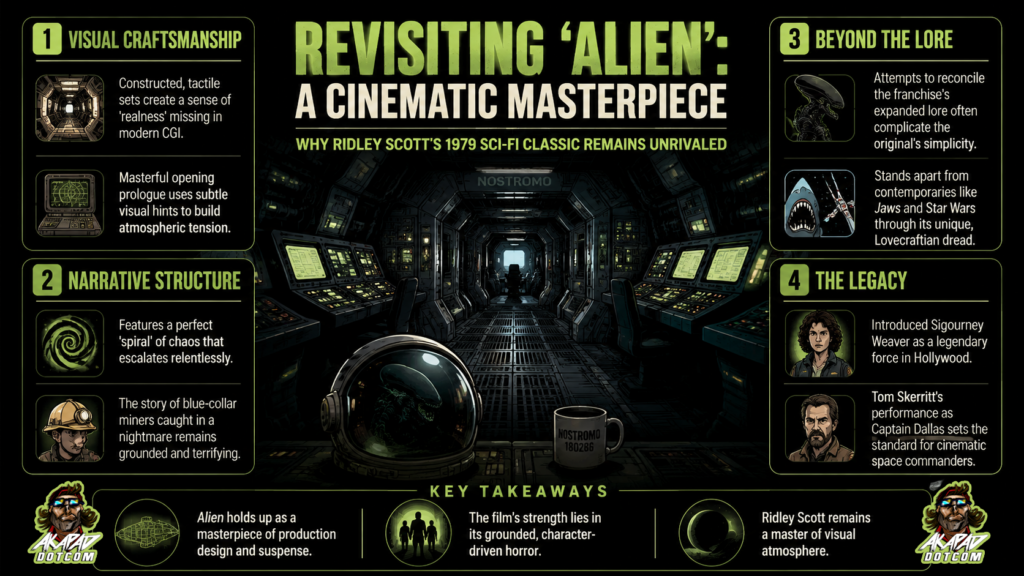
He compares the film’s flawless construction and Lovecraftian cosmic dread to Jaws, praises the tangible, fully-built sets of the Nostromo, and explores the corporate conspiracy elements while expressing frustration with how later franchise entries (like Prometheus) complicate the original’s clean, simple terror. AKAPAD also discusses Alien’s influence on James Cameron’s storytelling style, Sigourney Weaver’s breakout role, and why this late-70s classic stands shoulder-to-shoulder with Star Wars and Superman as a defining genre landmark.
Perfect listening during the current wave of Alien excitement (with Alien: Romulus, Alien: Earth, and more), this episode delivers relaxed, enthusiastic analysis from a true film buff who never stops finding something new in a beloved favorite.
Dim the lights, crank up the tension, and experience the chestburster terror all over again. Now streaming wherever you get your podcasts — and a great companion while rewatching Alien on Disney+
[00:00:01]
Introduction to the Film and Its Unique Viewing Experience
- The speaker opens by reflecting on the impact of the 1979 film Alien, highlighting its enduring ability to reveal new layers with each viewing.
- Alien is grouped with other late 1970s iconic sci-fi films like Superman and Star Wars, forming a “fantasy science fiction trilogy trifecta” of that era.
- The speaker notes a similarity between Alien and Ridley Scott’s other sci-fi masterpiece, Blade Runner, emphasizing how both films offer fresh perspectives upon repeated viewings.
- This phenomenon is described as uncommon, even for true film buffs, underscoring the film’s deep complexity and craftsmanship.
[00:00:47]
Film Buff Culture and Viewing Habits
- The podcast is geared towards dedicated film enthusiasts who do not all watch the same movies, which motivates the host’s “two movie a day” viewing policy.
- Alien’s impact varies with the viewer’s mindset and context, with the speaker sharing personal experiences of how the film resonates differently each time.
[00:02:02]
Personal Context During Viewing
- The speaker recounts watching Alien during a celebratory weekend in Cape May, New Jersey, described as the best New Jersey beach town, filled with family and friends.
- The atmosphere is one of joy, appreciation, and connection, which the speaker believes colors the film-viewing experience.
- The physical activity of throwing a football on the beach with family is mentioned as part of this joyful context.
[00:03:20]
Watching Alien in Context of Recent Events and Releases
- The viewing coincides with the release of Alien: Romulus, prompting an “Alien month” of content on the podcast.
- The speaker intentionally avoided re-watching the original Alien during this period because “everything that’s been said has been said” about it.
- The viewing happens after a long drive back to Philadelphia, ordering Chinese food, and feeling euphoric from the weekend’s experiences.
- The speaker paints a vivid social picture, mentioning the Lobster House as a favored sendoff location for their group.
[00:04:32]
Comparison Between Alien and Contemporary Films
- The speaker contrasts Alien with Jaws, a film often held up for its suspense and production hurdles (such as the malfunctioning shark prop).
- Alien, by contrast, is praised for its flawless construction despite some production glitches and lacking the same lore-driven fame as Jaws.
- Alien is described as evoking a Lovecraftian atmosphere, representing the fear of the unknown, particularly the vastness and danger of space.
- This Lovecraftian theme is linked to a documentary titled Alien Memory, which the speaker criticizes as “god-awful” and overly focused on this aspect.
[00:05:53]
Film’s Opening and Visual Realism
- The film’s opening shots of the Nostromo spaceship interiors—hallways, control rooms, living quarters—are highlighted as a carefully constructed, immersive setup for the horror to come.
- The speaker notes specific details like the shaking pods/canopies, emphasizing the tangible, believable construction of the ship’s environment.
- This realism is framed as surpassing Jaws in terms of immersion, despite both films being human dramas with underlying horror elements.
[00:07:22]
Comparison of Alien, Jaws, and Star Wars
- The speaker juxtaposes Alien and Jaws as comparable in tone and approach to human drama and suspense.
- Star Wars is excluded from this comparison due to its fundamentally different entertainment intent—more fantasy/adventure than horror or suspense.
- This framing is presented as an innovative way to think about Alien’s place in late-70s cinema, beyond the usual sci-fi categorization.
[00:07:59]
Plot Elements and Corporate Motives
- The activation of the Nostromo’s computer and the reflective effects on the space helmet are appreciated for their foreshadowing and cinematic quality.
- The crew’s debate about investigating the mysterious transmission is described as compelling.
- The speaker discusses the in-universe “evil corporation” that sends the crew to retrieve the alien lifeform, noting some ambiguity and evolving interpretations across the Alien franchise regarding the corporation’s true motives:
- Initially seen as a straightforward mission to bring back the creature “by any means necessary.”
- Later lore suggests a more specific agenda involving impregnating a crew member and transporting the alien in cryogenic stasis to bypass regulations.
- The speaker prefers to simplify this to the idea that the crew are ordinary workers caught in extraordinary circumstances.
[00:10:07]
Franchise Lore and Continuity Challenges
- The speaker expresses frustration with how later Alien films like Prometheus complicate or contradict the original Nostromo crew’s role as pioneers in encountering the alien species.
- The original movie’s narrative simplicity—miners on a job who are suddenly thrust into chaos—is favored over the convoluted mythology introduced in sequels and prequels.
- Watching Alien with knowledge of the expanded universe can complicate the viewing experience, detracting from its original impact.
[00:11:23]
Narrative Structure and Influence on Other Films
- The speaker comments on the film’s spiraling tension and escalation, which became a template for director James Cameron in movies like Aliens and The Abyss.
- The gradual and relentless worsening of the situation is a key storytelling technique originating with Alien.
- Sigourney Weaver’s emergence in Hollywood with this film is noted as significant.
- The character of Tom Skerritt’s Captain Dallas is praised highly, with the speaker preferring him over iconic characters like Han Solo.
[00:12:44]
Final Reflections and Streaming Release
- The episode closes by mentioning the release of Alien Earth on Hulu and Disney Plus, describing it as a “great streaming drop.”
- Ridley Scott is lauded as one of the two greatest living filmmakers, the other being Woody Allen, according to the speaker’s personal view.
- The host signs off enthusiastically, encouraging listeners to engage with the Alien franchise and the podcast’s coverage.
Summary Table: Key Films and Comparisons
| Film/Franchise | Key Traits Highlighted | Role in Discussion |
|---|---|---|
| Alien (1979) | Complex, evolving with each viewing; Lovecraftian horror; immersive ship design; template for escalation | Central subject; praised for craftsmanship and influence |
| Blade Runner | Similar viewing experience; sci-fi masterpiece by Ridley Scott | Comparative reference to Alien’s rewatchability |
| Jaws | Human drama; production challenges; suspense focus | Comparison point for Alien’s horror and narrative style |
| Star Wars | Fantasy/adventure, different entertainment intent | Excluded from direct comparison due to genre differences |
| Prometheus | Expands Alien lore, complicates original narrative | Critiqued for diluting the original film’s simplicity |
| Aliens, The Abyss | James Cameron’s films using Alien’s escalating tension template | Examples of Alien’s influence on sci-fi storytelling |
Key Insights
- Alien’s unique ability to reveal new details on repeated viewings distinguishes it among late 70s sci-fi films.
- The Lovecraftian theme of cosmic horror and the unknown is central to the film’s atmosphere, though the documentary Alien Memory’s focus on this is criticized.
- The film’s realistic set design and immersive visuals elevate it beyond typical genre fare and even beyond some contemporary classics like Jaws.
- The corporate conspiracy angle is somewhat ambiguous, with franchise retcons complicating the original straightforward mission narrative.
- Alien’s narrative escalation set a storytelling template that influenced major sci-fi films by James Cameron.
- Viewing Alien in isolation from expanded universe entries preserves its impact and simplicity.
00:00:01
quiet on the set. >> Grammar speed down production stage one action. >> It’s like every time every time I watch Alien, uh I got nothing in front of me, by the way, guys. So, we’re we’re just sitting down talking. Alien, whatever year it came out, whatever year, 1978, 1979, the late 70s was wild because you kind of get like Superman, the movie, Star Wars, and Alien, and it’s like this like fantasy science fiction trilogy trifecta, but every single time I watch Alien, I see something else. I just see the
00:00:47
movie slightly different every single time. Uh it’s so similar to Ridley Scott’s uh his other science fiction masterpiece uh Bladeunner. Every time I watch Bladeunner, it’s like you you see it differently and it’s so weird. There’s so few films that do that. And it doesn’t mean like time passed and you’re maybe a different person. I just mean the regular filmgoer, the true film buff, and that’s what we do here on the film buff podcast, but the true individuals that have skin
00:01:23
in the game because they have dedicated their lives in doing what we’re doing here in the podcast. And in so the audiences, you guys are doing it, too. We don’t watch all the same movies. That’s kind of why we have a two movie a day policy that I’m I’m hoping to solidify. Be on the lookout for the announcement episode. But Alien hits me in a different way every single time this time and I put it on. So, we have this like Cape May birthday party weekend for someone and we’re just in
00:02:02
Cape May, New Jersey, which in my view is the best of the best of all the New Jersey beach towns. You just don’t want to leave. like you go and and I’m there with my fiance and my extended family and I’m meeting new people and there there’s just a appreciation and joy that that I have and and um just being in the room sometimes being just being in the room. Uh I’m grateful. So I’m having this type of weekend. Uh, I come back from a day day two in the sun. Day two of drinking
00:02:38
in the sun. Day two of throwing the the foot. I love throwing the football on the beach. I just I love chalking that thing and catching it. I I’m like a dog. But I’m doing that with with with my brother-in-law and I come back and and Alien Earth, right? It’s it’s all over social media. It’s dropping dropping tonight. So, we’re we’re bumping our our our 8:00 release and but we’re we’re doing Alien. So, I come back and I put this movie on cuz I it’s I just feel like the run of
00:03:20
stuff we were doing, the run of content, if you will, that we were leaning into Alien, the release of Alien Romulus, and we did like a whole Alien month. I purposely left this film out because I said at the time everything that’s been said has been said about Alien. So, we did Alien Memory, which was this uh god-awful documentary. Don’t even bother going to If you want to hear me talk about it, just go to the episode. Listen to Peter. Don’t watch it. But I put this movie on and we’re
00:03:59
ordering Chinese food. Uh it’s not even late, but we’re just like exhausted. Two-hour drive to get back into Philly. But again, like euphoric from just really good backtoback beach days, back to back good nights. Uh there’s this place called the Lobster House that we all like to go to on the way out. Uh you know, one of my extended family uh suggest suggested that place and you know, he he went with us. But, you know, like it’s good good that he’s there. I’m not not trying to say
00:04:32
that. I’m just trying to paint the picture for you guys. But like everyone’s there. Like everyone you kind of want to be there is is at the lobster house. And that’s our sendoff. So again, like high on all of this, right? Come back, we put on Alien. And in my view like this movie is so perfectly made constructed. Uh it’s it’s wild to me where just of like the films around the same time people like hold Jaws up because you do have to compare this movie to Jaws. people hold jaws up and they they were
00:05:13
really able to sell that uh shark didn’t work stick and you know like that that sells the movie that caught fire in the press but alien kind of like again like it just comes out there I’m sure there’s some glitches in in in the production but it doesn’t have this lore around it that Jaws has but Alien like It literally caught Arno this Lovecraftian darker side. And I’m only saying Lovecraftian because that stupid alien memory documentary uh leaned in on that pretty heavily. But
00:05:53
but by Lovecraft, they’re speaking of the the the unknown of space, the unknown of exploration of what you’re you’re moving into. So, this movie begins with these interior shots of the Nostromo. We see hallways and control rooms and living quarters and it’s just moving through everything we’re about to see horror in. It’s a amazing setup. And I’m watching this movie and I’m just saying to myself, uh I again like there’s I know there’s two separate versions.
00:06:41
There’s like a special edition, but I’m thinking like is this in the special edition? Is this in the original original? I I don’t quite remember the movie opening this way. And then we have like the pods, the canopies like flip open. Watch. They shake a little at the top. I I always look for that. And I’m just saying to myself like none of this exists. Like all everything I’m looking at was built. So like already and I’m convinced it’s all real. Like we’re already a step up on Jaws.
00:07:22
But Jaws is like again as a human drama. It’s there but it echoes everything that’s in alien. So it comes like this to tick for tat comparison. I’m not even putting Star Wars in there cuz again like the intent of Star Wars uh as a piece of entertainment is far different than Jaws and Alien. And I’m not speaking to compare like the Ridley Scott and and Stephen Spielberg, but we’re trying to kind of introduce a way to think about this movie that that’s maybe not there yet because we innovate here on the Film
00:07:59
Puff podcast. And then the Nostromo computer turns on and I I love that reflection that it has on the space helmet again. like we know what’s going to happen with that space helmet. And I just saw like the opening minute of this movie as this prologue. Like all the hints, all the scenes that are now legendary, they all get teased before the crew even wakes up. And then yeah, the crew gets the transmission. And I love the the debate that they have. They have to go to the signal. They have to go
00:08:42
They have to go go to it. It’s kind of funny where uh you know like you I know they’ve reconed the intent of the evil corporation, but the evil corporation sending them to like bring back the creature. It would be like bring back the creature. uh as a like inside the ship by any means necessary with or without the the robot if the robot survives if the android survives like that’s got to be what the corporation says. Uh I know they like later in Alien they try and reccon to where they wanted they just wanted
00:09:28
someone impregnated and they wanted them frozen. They wanted them cry frozen to move through like customs or move through the red tape. Uh, you know, in Alien is a little bit more targeted and it’s a little bit more described or explained and it works though. But in this one, it really it you you kind of just want to take the recon stuff out of it. And then these were minors. These were people trying to do one job and they got called into another and then essentially all hell breaks loose. End of story.
00:10:07
Uh, I do feel like so much and and I didn’t even know I was going to go here, but it takes away Prometheus and like all these other things to where like why can’t these individuals the the crew of the Nostromo, why can’t be why can’t they be the ones that discovered this or the ones that that discovered it to a point and brought it a little bit further and then, you know, the rest of the Alien movies to continue to dissect and trying to get the creature and and that becomes the story. But they’ve they’ve gone
00:10:43
backwards with that uh lore or or mythology within the series. And that’s fine, but it’s increasingly difficult to watch this movie with a set of eyes that do that doesn’t involve the other movies. We always talk about the the the incubation period that this movie establishes. Uh, I don’t know. I really that’s so nominal at this point because I was just watching Big and Big has a similar like time frame problem where when does Josh Baskin’s uh like what when when does the magic kick in for
00:11:23
him? Because it seems to be overnight in the beginning and it seems to be minutes at the end. Whatever. Moving on. Great movie. Another Steven Swber reference there, right? But yeah, and then just the spiral, like the the way that this movie spirals is literally James Cameron’s template for uh aliens. It’s his template for um the abyss where it just keeps getting worse and worse and worse and worse. So, Gourney Weaver uh emerges in into Hollywood with this movie. Tom Scarret is one of the the great
00:12:05
space captains of all time. Like I I’ll get Tom Scarro over Han Solo any day of the week, Dallas. But really, like this this viewing was the the beginning of the movie and how uh interesting the shot selection was. I I was just like blown away. All right, AK Parish. Well, look look. Tonight is Alien Earth night. So, be on the lookout. I’m going to try and bring you uh Alien Earth as we march along because people are saying it’s it’s one of the great streaming drops. Isn’t that
00:12:44
amazing? Isn’t that exciting? Uh it drops tonight at 8:00 on Hulu and I believe Disney Plus if you have the combo package. Another Ridley Scott masterpiece. Uh, really. And you guys know I consider Ridley Scott, you know, one of the two greatest living filmmakers of all time. The other being Woody Allen. That’s my two-headed dragon. Love you guys. Rock and roll. Okay, that’s a wrap.

AKAPAD is a versatile thinker known across Philadelphia, Europe, and even in the vast Multiverse as The Electic One. By day, he excels as an IT Mastermind, assisting individuals, both big and small, with a wide range of simple and complex solutions. In contrast, he is also a talented illustrator, a passionate comic book enthusiast, a creative content creator, and an active live streamer. Additionally, his podcast, “AKAPAD The Film Buff Podcast,” boasts an impressive catalog of over 500 episodes available on nearly every major platform.

